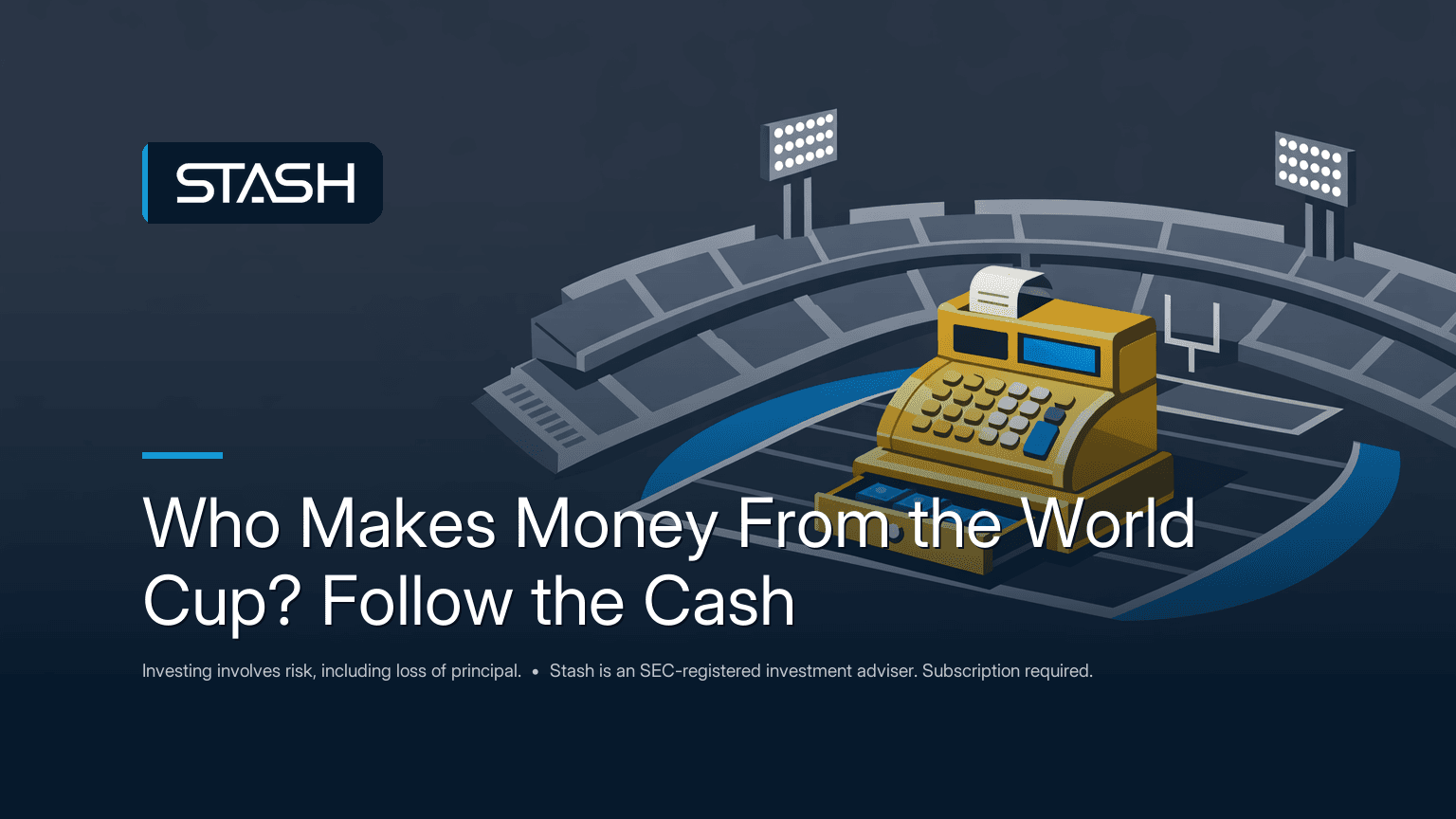
Who Makes Money From the World Cup? Follow the Cash
Published: Jul 21, 2026
By Ed Robinson, Co-Founder & Co-CEO, Stash · FINRA Series 7 & 63 · Graduate Diploma in Financial Planning · Last updated July 21, 2026
Spain won $51 million. FIFA made about $8.9 billion from the 2026 tournament, per SportsPro’s June 2026 summary of FIFA projections.
That is the angle most highlight reels missed. If you are asking who makes money from the World Cup and what does it teach investors, start here: the players win the trophy, but the owner of the platform collects the tolls. If you are new to markets, How to start investing is the pillar to bookmark. For more on reading stories like this, see Market news, strong earnings and sticky inflation.
What happened
CNBC reported that Spain beat Argentina 1-0 in extra time to win the 2026 World Cup, with Ferran Torres scoring the only goal. The final also had the tournament’s first halftime show, with Madonna, Justin Bieber, BTS, and Shakira among the performers.
The bigger business story was the expanded format. The 2026 World Cup had 48 teams, up from 32 in 2022. That meant 104 matches instead of 64, played over six weeks rather than four.
More games meant more inventory. More tickets. More broadcast hours. More sponsor slots. CNBC reported that tickets ranged from $60 to more than $10,000, with TicketData putting the median admission price above $900.
The 8% economy
The prize pool was huge in normal life terms: $655 million, per FIFA figures cited by Financial Express. Spain’s federation gets $51 million. Argentina gets $34 million. Even teams that lost earlier received payments, down to $9 million.
But next to the full machine, that pool was small. SportsPro reported that FIFA projections put about $8.9 billion of the 2023-2026 cycle’s revenue from the 2026 tournament. The $655 million prize pool is roughly 7% of that tournament revenue.
Broadcast rights were the largest single stream, at about $3.9 billion, per SportsPro and MarketScale. Fox Sports and Telemundo alone paid about $1.25 billion for U.S. rights, up about 94% from Qatar 2022. Sponsorship revenue was projected at $2.4 billion to $2.7 billion, per Ampere Analysis and SportsPro.
That is the market lesson. FIFA is the house. The players and federations are essential, but they are still sharing a slice. The bigger pool goes to the entity that controls the scarce asset: the global event.
The sponsor-stock myth
A common market story goes like this: find the World Cup sponsors, then ride the attention. It sounds clean. The data is messier.
IG UK looked at a basket of major World Cup sponsors across the 2010, 2014, 2018, and 2022 tournaments, from 30 days before the tournament through three months after. In that window, the sponsor basket averaged a 7.1% gain versus 1.9% for the S&P 500. That is historical performance for education, not a forecast.
The spread mattered more than the average. Nike (NKE) averaged 17.7% in those windows, including 38.7% in 2022, per IG UK. Coca-Cola (KO) averaged 8.6%. AB InBev (BUD) averaged 7.9%. Hyundai (HYMTF) averaged 7.0%. Adidas (ADDYY) averaged 1.6%, behind the S&P 500. Visa (V) averaged 1.9%, in line with the market.
Two media names show the other side of the event economy. Fox (FOX): Fox Sports was part of the U.S. rights package that helped fund FIFA’s broadcast revenue. Comcast (CMCSA): Comcast owns NBCUniversal, parent of Telemundo, the Spanish-language U.S. rights holder.
The warning is not that sponsors are bad. It is that a sponsor logo is not an investment thesis. Since the Qatar 2022 final on Dec. 18, 2022, Adidas shares were up about 44% while Nike shares were down about 59%, per Poland Insight and market data. The winning-team supplier did not predict the winning stock.
The underadvised gap
The World Cup is a mirror. Billions watch. Far fewer own a piece of the businesses that sell the ads, rights, shoes, drinks, and payment rails around the event.
Gallup’s April 2026 Economy and Personal Finance survey found that 58% of U.S. adults owned any stock, down from 62% a year earlier. The Federal Reserve’s 2025 SHED report found that only 37% of U.S. adults held stocks, bonds, ETFs, or mutual funds outside a retirement account.
The gap gets sharper at the top. The Federal Reserve’s Q1 2026 Distribution of Financial Accounts showed that the top 10% of U.S. households by wealth owned about 87% of household stock wealth, or roughly $48 trillion. The top 1% owned more stock than the bottom 90% combined, about $27.6 trillion.
This is the underadvised middle: the customers who don't already have a private banker. Stash is a regulated investment adviser — not a bank, and this is general guidance; what's right for you depends on your specific situation.
Historical context
Spain has been here before. In 2010, Andrés Iniesta scored in extra time against the Netherlands in South Africa to give Spain its first World Cup title.
That final felt like the peak of a soccer era. But the business model kept growing after the trophy ceremony. The tournament added more media money, more sponsor layers, and eventually more teams.
The same pattern shows up in markets. A single event can feel like the whole story while it is happening. Years later, the lasting lesson is often about ownership, cash flows, and who controls distribution.
The durable lesson
The durable lesson is not “trade the World Cup.” It is to notice who owns the system when everyone else is watching the show.
That idea applies beyond sports. An IPO can create the same hype loop, so it helps to know What is an IPO? before the headlines get loud. A bear market can punish crowded stories, which is why What is an index fund? is worth understanding before fear takes over.
For everyday investors, the World Cup points to three useful questions:
Who earns recurring revenue from this event?
Is the popular story already priced in?
Am I relying on one company, or am I diversified across many?
That is not personalized advice. It is a way to slow down before turning a headline into a portfolio move.
Frequently asked questions
Who makes money from the World Cup?
FIFA earns the largest share through broadcast rights, sponsorships, licensing, hospitality, and ticket-related revenue. In 2026, FIFA was projected to generate about $8.9 billion from the tournament, per SportsPro’s summary of FIFA projections. Federations, clubs, broadcasters, sponsors, host cities, vendors, and players also make money, but not in the same way.
Do World Cup sponsors usually beat the market?
Not reliably. IG UK found that a basket of major sponsors averaged 7.1% around the last four tournaments it studied, versus 1.9% for the S&P 500. But individual results varied a lot. Historical sponsor performance is not a reason, by itself, to make a trade.
What does the World Cup teach investors?
It teaches that attention and ownership are different. Fans may pay for tickets, jerseys, streams, and drinks. Owners of the platforms, rights, and businesses collect revenue from that attention. For investors, the lesson is to look past the spectacle and ask who controls the cash flows.
Can I invest through a retirement account instead of a regular brokerage account?
Many people use both, depending on their goals and tax situation. For tax year 2026, the IRA contribution limit is $7,500 if you are under age 50, or $8,600 if you are age 50 or older, including a $1,100 catch-up. That is a combined cap across all Traditional and Roth IRAs, and it cannot exceed the year’s taxable compensation. Roth direct-contribution MAGI phaseouts are $153,000-$168,000 for single or head of household filers, $242,000-$252,000 for married filing jointly, and $0-$10,000 for married filing separately. RMDs generally begin at age 73. Excess IRA contributions may face a 6% excise tax per year.
Does Stash give advice on specific World Cup stocks?
No. Stash Learn articles do not recommend specific stocks or single securities. Stash provides general financial guidance, not personalized recommendations. Investing involves risk, including possible loss of principal.
5 companies that could be impacted
Fox Corporation (FOX) - Fox Sports held U.S. broadcast rights tied to FIFA’s largest World Cup revenue stream.
Comcast Corporation (CMCSA) - Comcast owns NBCUniversal, whose Telemundo unit held Spanish-language U.S. broadcast rights for the tournament.
The Coca-Cola Company (KO) - Coca-Cola was cited as a major World Cup sponsor in the article’s discussion of sponsor exposure around the event.
Nike, Inc. (NKE) - Nike was cited in the article’s World Cup sponsor and team-supplier performance discussion.
Visa Inc. (V) - Visa was cited as a major World Cup sponsor in the article’s discussion of sponsor exposure around the event.


Explore these on Stash
These ETFs are available to invest in on Stash. This list is educational and is not a recommendation to buy any security.
iShares Core U.S. Aggregate Bond ETF (AGG) - Holds bonds
Vanguard Long-Term Bond ETF (BLV) - Holds bonds
Vanguard Total World Bond ETF (BNDW) - Holds bonds
Vanguard Total International Bond ETF (BNDX) - Holds bonds
Bottom line
The World Cup is the loudest sporting event on earth, and in 2026 it became a roughly $9 billion lesson in ownership: fans pay for the show, while owners of rights, platforms, and businesses collect from it. Which side of that line you are on is not fate; it is a choice you can understand before the next headline arrives.
Important disclosures
This article mentions Nike (NKE), Coca-Cola (KO), Visa (V), Adidas (ADDYY), Comcast (CMCSA), Fox (FOX), and AB InBev (BUD) as neutral examples tied to World Cup sponsorship, media rights, or market data. They are not recommendations.
Market data can change. Past performance does not predict future results. Tax rules can be complex, and tax outcomes generally depend on your facts, so consider speaking with a qualified tax professional.
Investing involves risk, including the possible loss of principal. See full disclosures at www.stash.com/disclosures.
Educational only and is not a recommendation to buy, sell, or hold any security. See full disclosures at www.stash.com/disclosures.
General information only. Stash does not provide tax or legal guidance. See full disclosures at www.stash.com/disclosures.
IPOs and SPACs can be highly volatile and involve significant risk. Availability through any particular brokerage is not guaranteed, and Stash does not offer access to IPO allocations.
Stash is not a bank. Banking services are provided by a partner bank, and FDIC insurance is provided through that partner bank.
Educational only and does not constitute investment, legal, accounting, or tax advice. See full disclosures at www.stash.com/disclosures.

Written by
Team Stash
We want to turn money into a source of hope and opportunity. We teach people how to build good habits, save more and make it easy and affordable to get started investing. So far, we’ve helped over 6 million people create a more secure financial future with our expert advice and award winning investing app.
Related articles
financial-news
Jul 27, 2026
LeBron's NBA salary just went from ~$52.8M to ~$3.9M. His wealth didn't. Here's the money lesson.

financial-news
Jul 27, 2026
Your Money Headlines this Week
financial-news
Jul 21, 2026
AMC had its biggest quarter in 106 years. The stock is still down 99%. Both are true.
financial-news
Jul 21, 2026
Who Makes Money From the World Cup? Follow the Cash
financial-news
Jul 09, 2026
You already own NVIDIA (yes, you). Here's how much.
financial-news
Jul 01, 2026
Bitcoin's Worst Month in Years: What It Means for You

By using this website you agree to our Terms of Use and Privacy Policy. To begin investing on Stash, you must be approved from an account verification perspective and open a brokerage account.