LeBron's NBA salary just went from ~$52.8M to ~$3.9M. His wealth didn't. Here's the money lesson.
Published: Jul 27, 2026
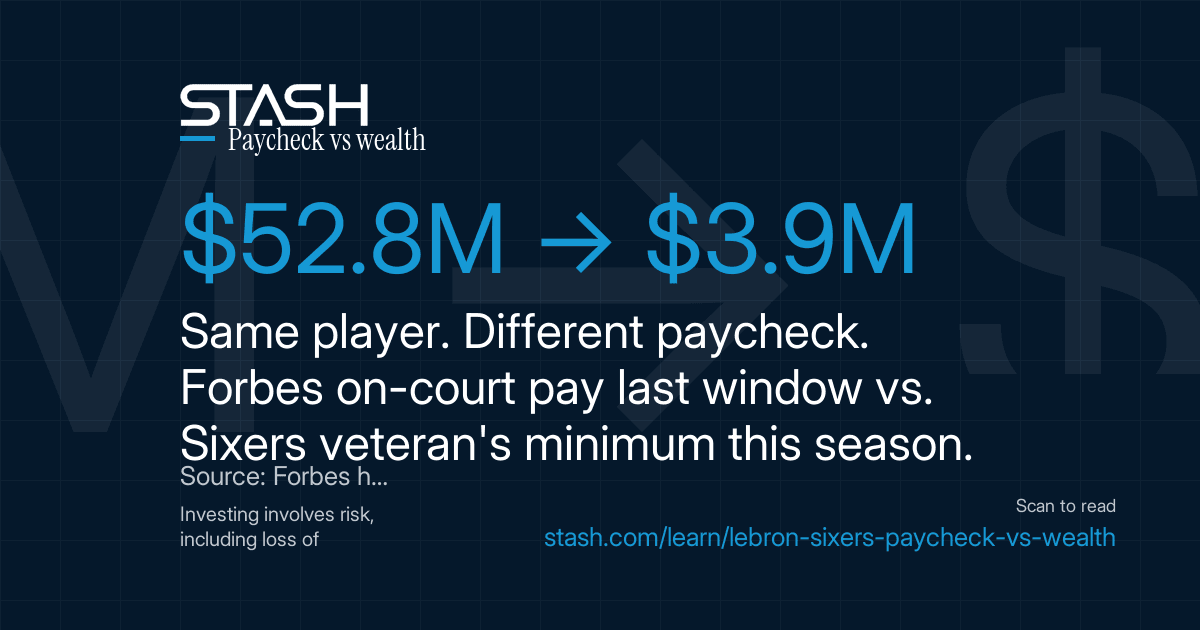
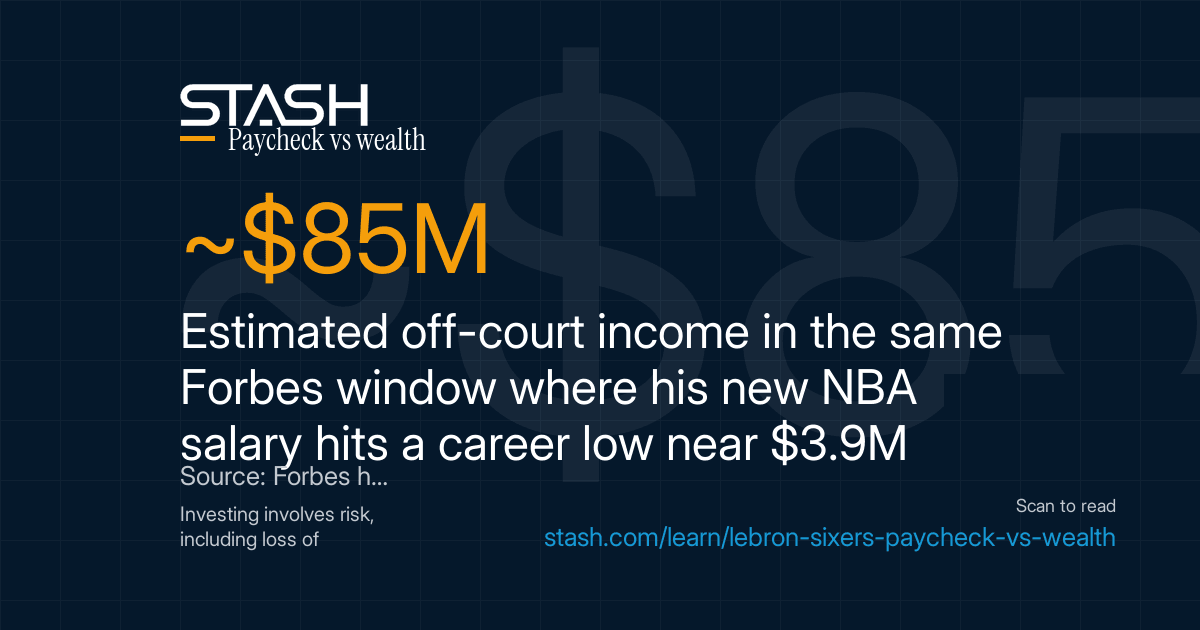
LeBron James's NBA salary is set to fall 93% this season, from about $52.8 million to about $3.9 million, per Forbes' 2026 highest-paid athletes list and Spotrac. That Sixers deal is a veteran's minimum worth roughly $8 million over two years. In the same Forbes window, his off-court income was still estimated at about $85 million. His paycheck cratered. His wealth did not. Most households do not have that gap. That gap is the real money story.
Send this to anyone who thinks a paycheck is a financial plan.
What happened
On July 24, 2026, LeBron James agreed to join the Philadelphia 76ers. The NBA logged the signing as official on July 26. The deal is a two-year veteran's minimum worth about $7.95 million total: roughly $3.88 million in 2026-27 and about $4.07 million in 2027-28 with a player option, per Spotrac. He is joining a roster already built around Joel Embiid, Tyrese Maxey, and Jaylen Brown.
Sports media covered the pay cut. Cap writers covered the apron math. This piece is about something quieter: what it means when a paycheck stops being the whole financial story.
The gap most coverage misses
A salary is what you earn this year for work. Wealth is what you keep: cash, investments, equity, and other assets that can fund your life even when the paycheck changes.
In Forbes' May 2026 athlete-pay ranking, LeBron's total earnings were estimated at $137.8 million for the measured window: about $52.8 million on the court and about $85 million off it. Forbes also estimates his net worth around $1.4 billion. Those are estimates, not an audited personal balance sheet. The direction of the story is still clear. Career NBA salary alone is already about $581 million, per Spotrac. The paycheck was never the whole pile.
This is not a celebration of billionaire math. It is a translation. When salary is only one slice of your financial life, a pay cut can be a choice. When salary is your financial life, the same cut feels like free fall. That is the underadvised reality for a lot of households in the middle: the W-2 is the plan.
What this means for you
You do not need an NBA contract to use the same idea. You need runway outside the paycheck.
Build cash that buys time. An emergency fund is the boring version of "I can take a worse short-term paycheck without blowing up my life." It is also what keeps a surprise bill from becoming a credit-card spiral.
Invest on a schedule, not a mood. The Stash Way is regular investing over time. The habit compounds even when headlines are loud.
Treat your job as income, not as the entire nest egg. If every dollar of future security depends on next month's direct deposit, a layoff, a bad boss, or a temporary pay cut has too much power over you.
This is general guidance, not personalized advice. What fits your situation depends on your own cash needs, debt, and goals. Stash is a registered investment adviser. We help you think through the process; we do not claim one path fits everyone.
One Stash proof point fits here: plans starting at $3 a month put guidance in your phone so building assets outside the paycheck is a habit, not a once-a-year resolution.
The FOMO tax hits your wallet first
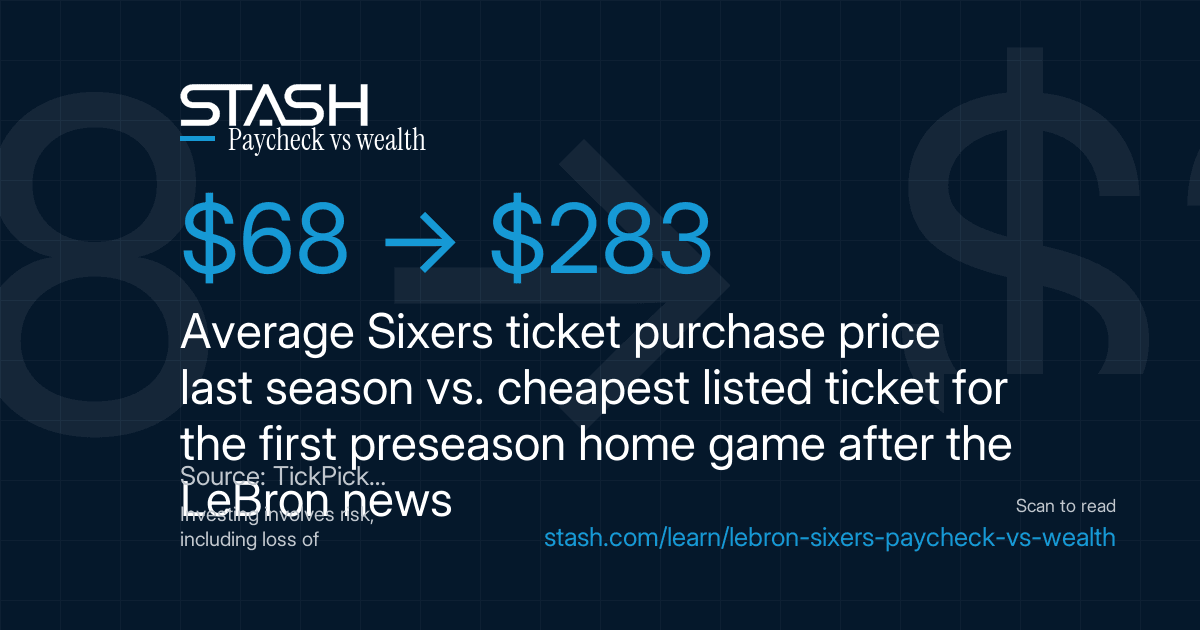
Before any stock chart moves, culture moments tax your cash. After the Sixers news, TickPick data circulating on July 25 showed the average purchase price for a Sixers game last season at $68, while the cheapest ticket listed for the team's first preseason home game sat at $283. That is more than a 4x jump from last season's average to this week's floor price on one early game.
Tickets are optional. The money lesson is not. When a culture moment spikes prices, the useful questions are the same ones you ask before any big spend: Does this fit my plan? Am I raiding next month's investing contribution to buy the vibe? Would I still want this seat at this price next week when the group chat cools off?
Fun is allowed. Undoing your Auto-Stash to chase a preseason seat is a different decision. For more on reading loud moments with a cooler head, see how to read market news as an everyday investor.
Ignore the "LeBron stocks" noise
You will see headlines that treat a jersey move like a stock tip. Treat that as entertainment, not a thesis.
Take a simple materiality check, the same frame we use for event-driven news like the World Cup investing explainer. Nike (NKE) is a neutral example here, not a recommendation. Nike reported about $46.4 billion in fiscal 2026 revenue, per the company's June 30, 2026 earnings release. Even a $100 million merch or endorsement bump that sounds huge in a group chat would be about 0.2% of that annual revenue before costs, taxes, and everything else that hits a real income statement. Stocks move for many reasons that have nothing to do with one free-agency headline.
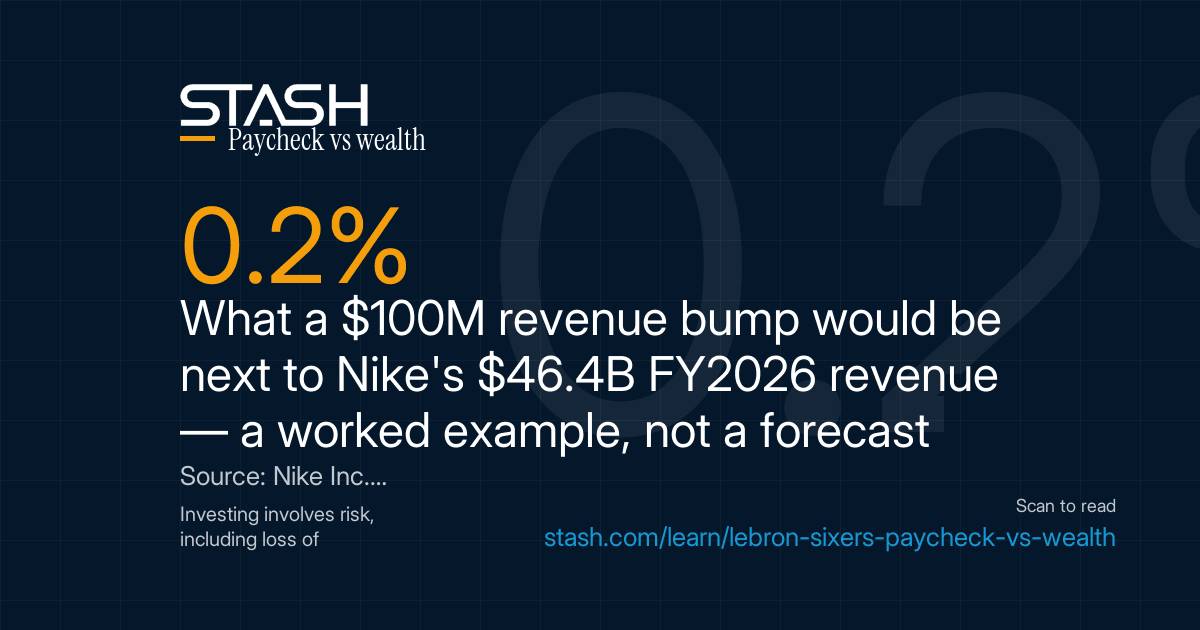
This example is a hypothetical illustration only. It is not a prediction about Nike, LeBron, or any security. The point is the filter: excitement and materiality are different numbers. If you already own a broad market fund, you already own slices of many companies that touch sports, media, and apparel. Chasing one headline on top of that is usually concentration dressed up as a take. For the sizing mindset, see what is diversification?.
Frequently asked questions
Is this just about being rich?
No. The useful lesson scales down. Assets outside your paycheck — even small, automatic ones — buy choices. Choices are what turn a temporary pay cut, a job change, or a loud culture moment into something you can absorb.
Should I invest in Nike or other "LeBron stocks"?
This article is not a recommendation to buy, sell, or hold any security. Nike appears only as a neutral example for materiality math. Event headlines are a weak reason to concentrate a portfolio.
What should I actually do with my money after a moment like this?
Protect cash needs first. Keep investing on a schedule if your plan already calls for it. Skip portfolio changes driven by sports free agency. If you want a guided path, start with an emergency fund target and a recurring investing habit, then size any single-name ideas on purpose.
Did LeBron really take a pay cut?
Yes, on NBA salary. Forbes had his on-court pay around $52.8 million in the 2026 athlete-pay window. The Sixers deal pays about $3.9 million in year one, per Spotrac. Off-court income and existing assets are why that cut does not read like a household crisis.
Is Forbes net worth a hard number?
No. Forbes publishes estimates. Treat ~$1.4 billion as an attributed estimate, not a bank statement. The investing lesson does not require the exact digit. It requires the gap between paycheck and wealth.
Related reading
What Is Diversification?
How to read market news as an everyday investor
Bottom line
LeBron can take the minimum because his paycheck stopped being his nest egg years ago. Your version of that story is simpler: build assets outside the W-2 so a loud week — or a hard year — does not get to rewrite your whole plan. Assets buy choices. That is the money story worth keeping.
Screenshot the paycheck card. Send it to anyone who confuses salary with a plan:
Important disclosures
Investing involves risk, including the possible loss of principal. Past performance is not a guarantee of future results.
This article is for educational purposes only and is not a recommendation to buy, sell, or hold any security, including Nike (NKE) or any other company named as a neutral example.
Forbes athlete-pay and net-worth figures are third-party estimates for a published measurement window. They are not audited personal financial statements and are cited for context only.
Contract salary figures are based on publicly reported Spotrac estimates and contemporaneous reporting as of July 26–27, 2026, and can change with official team disclosures.
Ticket prices cited reflect secondary-market figures attributed to TickPick as reported on July 25, 2026. Prices change quickly and vary by game, seat, and platform.
The Nike materiality example ($100 million next to $46.4 billion FY2026 revenue) is a hypothetical illustration only. It is not a forecast of Nike revenue, endorsement economics, or stock performance.
Diversification and dollar-cost averaging do not ensure a profit or protect against loss.
Stash offers access to investment and other accounts for a monthly subscription fee; current plan pricing is described at stash.com. Other fees may apply; see the fee schedule for details. Fees reduce your returns.
Stash does not provide tax or legal guidance. Consult a qualified tax or legal professional about your own circumstances.
This material is for informational and educational purposes only and does not constitute investment, legal, accounting, or tax advice. The information reflects market conditions as of publication and may change without notice. Stash makes no guarantees regarding accuracy or future performance. Investing involves risk, including possible loss of principal. Examples are for illustrative purposes only and not recommendations to buy or sell any security or strategy. Past performance does not guarantee future results. For full disclosures, visit www.stash.com/disclosures.
This material reflects general information, not individualized financial, legal, or tax guidance. Stash is a registered investment adviser; what is right for you depends on your specific situation.
Nothing in this article is a celebrity endorsement of Stash or of any security. LeBron James is discussed as a public news event only.
This is a hypothetical illustration of how market volatility and percentage fluctuations can impact the value of a single-name investment. Actual results will vary due to market conditions, volatility, taxes, fees, and subscription costs. This example is for general illustrative and educational purposes only and is not indicative of the future performance of any actual investment or investment strategy. All investments involve risk, including possible loss of principal.

Written by
Team Stash
We want to turn money into a source of hope and opportunity. We teach people how to build good habits, save more and make it easy and affordable to get started investing. So far, we’ve helped over 6 million people create a more secure financial future with our expert advice and award winning investing app.
Related articles
financial-news
Jul 27, 2026
LeBron's NBA salary just went from ~$52.8M to ~$3.9M. His wealth didn't. Here's the money lesson.
financial-news
Jul 27, 2026
Your Money Headlines this Week
financial-news
Jul 21, 2026
AMC had its biggest quarter in 106 years. The stock is still down 99%. Both are true.
financial-news
Jul 21, 2026
Who Makes Money From the World Cup? Follow the Cash
financial-news
Jul 09, 2026
You already own NVIDIA (yes, you). Here's how much.
financial-news
Jul 01, 2026
Bitcoin's Worst Month in Years: What It Means for You

By using this website you agree to our Terms of Use and Privacy Policy. To begin investing on Stash, you must be approved from an account verification perspective and open a brokerage account.