You already own NVIDIA (yes, you). Here's how much.
Published: Jul 09, 2026
In this article:
- Wait, I already own NVIDIA?
- How to check your real NVIDIA exposure
- How NVIDIA got this big, and why that cuts both ways
- Why one hot stock pulls so hard
- The number that fuels the FOMO, and why it is a trap
- So what should you actually do?
- Doing it on Stash
- Related reading
- Bottom line
- Important disclosures
- FAQ: NVIDIA stock questions
Should you buy NVIDIA? Should you sell it? Here is the part almost everyone misses before they decide: you already own NVIDIA. If you hold an S&P 500 index fund, a target-date retirement fund, or most broad U.S. stock funds, a slice of your money is already in it. NVIDIA is the single largest stock in the index, about 7% of it, the biggest one-company weight in 35 years of data, according to Leuthold Group figures cited by The New York Times. So the real question is not buy or sell. It is how much of your money is already riding on one stock, whether you chose it or not.
Send this to anyone who texted you "should I buy NVIDIA?" this week. The honest answer starts with a number they have never checked: their own.
Know someone stressing over NVIDIA? Send them the two-minute reality check:
NVIDIA closed around $204 a share on July 8, 2026, worth about $4.9 trillion, the most valuable company on Earth. The "buy or sell" question feels urgent because the stock has been a rollercoaster: it hit an all-time high of $235.47 on May 14, briefly cracking $5.7 trillion, then shed more than $1 trillion in market value over about two months before recovering some of it. But the loudest question is the wrong one. NVIDIA is clearly a great company. What you can actually control is how much of one company belongs in your money, especially when you probably already own a chunk of it.
Wait, I already own NVIDIA?
Almost certainly, yes, if you hold any broad U.S. fund. Because the S&P 500 is weighted by size, the biggest company gets the biggest slice, and NVIDIA is now the biggest company there is.
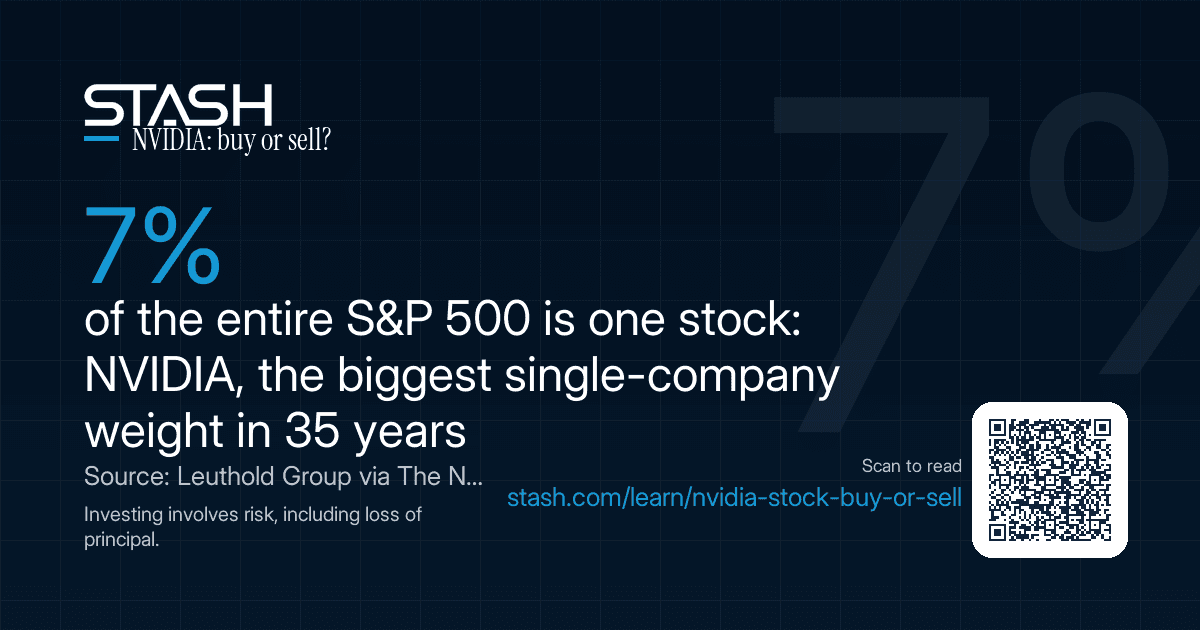
Put plainly: for roughly every dollar you put into an S&P 500 index fund, about seven cents goes straight to NVIDIA, whether you meant to buy it or not. NVIDIA, Apple, and Microsoft together are close to a fifth of the whole index, and the "Magnificent 7" tech names are about a third of it. That is not a knock on index funds; it is a reminder that "diversified" has quietly become more concentrated than it looks. Before you decide to buy more, it helps to know how much you already hold.
How to check your real NVIDIA exposure
Most people guess wrong here, because they only count the shares they bought on purpose. Your true bet on NVIDIA is bigger. Here is a two-minute way to estimate it:
Count your direct shares. Add up any NVDA you bought on its own. That part is easy.
Find the hidden slice. Take everything you hold in S&P 500 funds, target-date funds, and broad U.S. funds, including your 401(k), and multiply by about 7%. That is the NVIDIA you own without picking it.
Add them up, then divide by your whole portfolio. That percentage is your real bet on one company.
Here is how fast it adds up. Say you have $20,000 invested: $15,000 across index and target-date funds, and $2,000 you put directly into NVDA. Those funds already hold about $1,050 of NVIDIA, roughly 7% of the $15,000. Add the $2,000 you bought directly, and about $3,050, or roughly 15% of your money, rides on one stock, before you ever thought of yourself as an NVIDIA investor. This example is hypothetical and for illustration only. Run your own number before you decide to add more; most people are more concentrated than they realize.
How NVIDIA got this big, and why that cuts both ways
NVIDIA makes the chips that train and run artificial intelligence, and demand has been staggering: record revenue of $81.6 billion last quarter, up 85% from a year earlier, with the data center business alone about 92% of the company, per its SEC filing. That growth is the engine behind the stock. It is also the risk. When one business line drives almost all the revenue, and that line depends on a handful of giant customers building AI data centers, the growth is real but so is the concentration, inside the company and inside your portfolio.
Why one hot stock pulls so hard
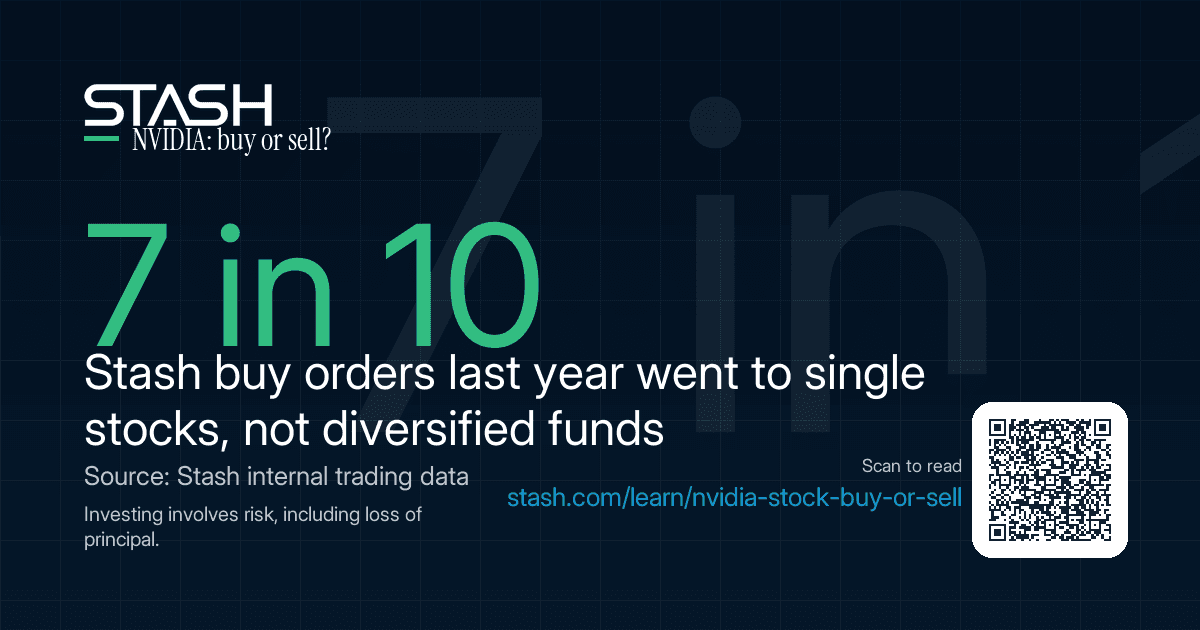
Here is something we can see from inside Stash that most coverage cannot. Over the past year, about 7 in 10 stock and ETF buy orders on Stash went to single stocks rather than diversified funds. The pull toward one exciting name is strong, and the most famous stock in the world pulls hardest of all.
That pull is exactly how concentration sneaks in. Say you have $10,000 across broad funds and a few stocks, and you add $2,000 of NVIDIA because it feels like a rare chance. Now 20% of your portfolio rides on one company, before you even count the NVIDIA already inside your funds. If that stock drops 40%, your overall portfolio loses at least 8% from that one position, even if everything else holds flat. NVIDIA swung from $235 in May to under $200 within two months, so that is not a rare kind of move. This example is hypothetical and is not a forecast for NVIDIA or any other stock.
The number that fuels the FOMO, and why it is a trap
You have seen the screenshot. If you had put $1,000 into NVIDIA at its 1999 IPO, at $12 a share, you would have bought about 83 shares. After six stock splits over the years, those would have become roughly 40,000 shares, worth about $8 million today.
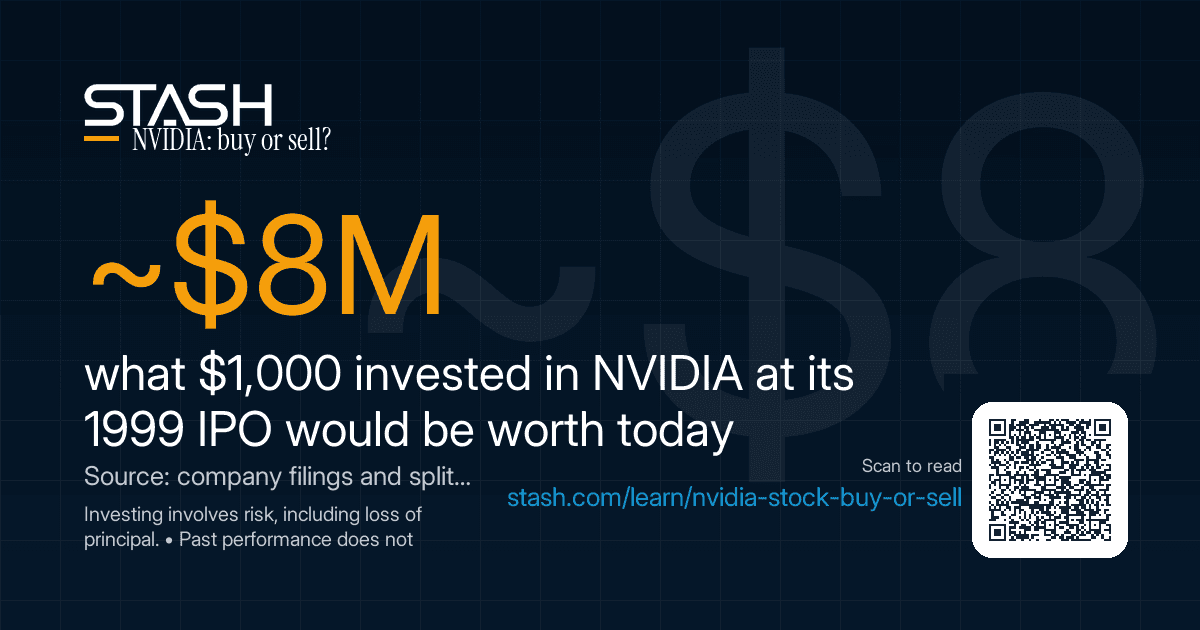
It is a jaw-dropping return, and it is exactly why the fear of missing out is so strong. But that number is a rear-view mirror. It tells you what a 26-year hold through a once-in-a-generation technology shift did. It says nothing about what the next dollar you invest at a $4.9 trillion valuation will do; a company that already grew 800,000% cannot repeat that from here. Past performance is the most seductive, and least reliable, reason to buy.
So what should you actually do?
Whether you own 2 shares or you are eyeing your first buy, skip the buy-or-sell coin flip and do what an advisor would do: size the position on purpose.
Count your real exposure. Run the two-minute check above so you know your true NVIDIA percentage, funds included, not just the shares you bought on purpose.
Pick a ceiling. Decide the most you want any single company to be of your total money, and hold that line. There is no one right number, but no single stock should be able to sink your plan on its own.
Right-size to fit. If NVIDIA is over your ceiling, trimming back to your target is a sizing decision, not a market call. If it is under and you want more, add slowly and dollar-cost average rather than timing a volatile stock. If you would rather not manage it stock by stock, a diversified or managed portfolio spreads the bet for you.
None of this is a recommendation to buy, sell, or hold NVIDIA. It is the conversation an advisor would walk you through, which is exactly what Stash is built to be.
Doing it on Stash
If you have run the numbers and want to add in the right size, or trim back to it:
Add small with fractional shares. Search NVDA and choose a dollar amount, so a $200 stock does not require a $200 minimum.
Average in with Auto-Stash. Schedule small recurring buys to spread your entry price over time rather than guessing the bottom.
Count what you already own first. Before adding more, remember the NVIDIA sitting inside your funds. Keeping one company in proportion is the whole job of a financial advisor in your pocket.
Prefer not to pick? A diversified or managed portfolio keeps you from stacking a bet on top of the bet already inside your funds.
None of this is a recommendation to buy, sell, or add to NVDA. How much of any one stock fits your portfolio depends on your own situation.
FAQ: NVIDIA stock questions
Do I already own NVIDIA without knowing it?
Probably. NVIDIA is about 7% of the S&P 500, so most index funds, target-date retirement funds, and broad U.S. funds hold a meaningful slice of it. If you have a 401(k) or an S&P 500 fund, you likely have NVIDIA exposure already, on top of any shares you bought directly.
How much of my portfolio should be in one stock?
There is no single right number, but the principle is simple: no one company should be able to sink your plan on its own. Counting both your direct shares and the exposure inside your funds keeps you from being far more concentrated than you realize.
Should I sell my NVIDIA now?
That depends on why you own it and how big the position really is, funds included, not on the recent swing alone. Selling only because the price moved locks in the result and often leads to buying back higher. If NVIDIA has become an oversized share of your portfolio once you count everything, trimming it back to a size you are comfortable with is a portfolio-sizing decision, not a call on the stock itself. This is general guidance, not a personalized recommendation.
Is NVIDIA overvalued?
Analysts are split. After the recent drop its forward price-to-earnings ratio fell to around 18, the lowest since early 2019 according to Bloomberg data, which bulls call reasonable for its growth and bears call risky for a company this size. Fair value is a live debate, which is one more reason to keep any single position modest. NVIDIA reports earnings again on August 26, 2026.
Can I buy NVIDIA on Stash?
Yes. NVIDIA (NVDA) trades publicly, so you can buy it on Stash like any other listed stock, including fractional shares so you can start small and dollar-cost average over time.
Related reading
What Is Diversification?
Bottom line
NVIDIA is the most valuable company in the world, and you already own a piece of it through your funds, probably more than you realized. That makes the real decision less about buy or sell the hype and more about how much of one company belongs in your plan once you count everything. Check your real number, pick a ceiling, and size on purpose. The headline is loud; your process can be quiet.
Important disclosures
Investing involves risk, including the possible loss of principal. Past performance is not a guarantee of future results.
This article is for educational purposes only and is not a recommendation to buy, sell, or hold any security, including NVDA.
Any hypothetical example is for illustration only. It is not a prediction or guarantee of performance, does not reflect actual results, and does not account for fees, taxes, or other costs.
The exposure estimate and the concentration examples are simplified illustrations. Actual fund holdings and index weights vary by fund and change over time; check your specific fund's holdings for its real NVIDIA weight.
The IPO return example is a historical illustration based on split-adjusted shares and a recent market price; it does not predict future results and changes as the stock price moves.
Investing in IPOs and newly public companies can involve added risk and volatility. The 1999 IPO reference is a historical example only; it is not an offer, solicitation, or recommendation to invest in any IPO or security.
Prices, valuations, index membership, index weights, and analyst views cited reflect publicly reported information as of early July 2026 and change over time.
Diversification and dollar-cost averaging do not ensure a profit or protect against loss.
Stash offers access to investment and other accounts for a monthly subscription fee; current plan pricing is described at stash.com. Other fees may apply; see the fee schedule for details. Fees reduce your returns.
This article summarizes publicly reported company financial results for context only. It is not a recommendation regarding any security and is not a solicitation or offer to buy or sell any security.
Stash does not provide tax or legal guidance. Consult a qualified tax or legal professional about your own circumstances.
This material reflects general information, not individualized financial, legal, or tax guidance. Stash is a registered investment adviser; what is right for you depends on your specific situation.
Stash trading statistics reflect aggregate Stash customer activity: single-stock versus fund buy orders over the trailing 12 months ending June 2026. They describe past customer behavior, are not investment advice, and are not a recommendation to buy, sell, or hold any security.
This is a hypothetical illustration of how market volatility and percentage fluctuations can impact the value of a single-name investment. Actual results will vary due to market conditions, volatility, taxes, fees, and subscription costs. This example is for general illustrative and educational purposes only and is not indicative of the future performance of any actual investment or investment strategy. All investments involve risk, including possible loss of principal.
IPOs and SPACs can be highly volatile and involve significant risk. Availability through any particular brokerage is not guaranteed, and Stash does not offer access to IPO allocations.
Educational only and does not constitute investment, legal, accounting, or tax advice. See full disclosures at www.stash.com/disclosures.

Written by
Team Stash
We want to turn money into a source of hope and opportunity. We teach people how to build good habits, save more and make it easy and affordable to get started investing. So far, we’ve helped over 6 million people create a more secure financial future with our expert advice and award winning investing app.
Related articles
financial-news
Jul 27, 2026
LeBron's NBA salary just went from ~$52.8M to ~$3.9M. His wealth didn't. Here's the money lesson.
financial-news
Jul 27, 2026
Your Money Headlines this Week
financial-news
Jul 21, 2026
AMC had its biggest quarter in 106 years. The stock is still down 99%. Both are true.
financial-news
Jul 21, 2026
Who Makes Money From the World Cup? Follow the Cash
financial-news
Jul 09, 2026
You already own NVIDIA (yes, you). Here's how much.
financial-news
Jul 01, 2026
Bitcoin's Worst Month in Years: What It Means for You

By using this website you agree to our Terms of Use and Privacy Policy. To begin investing on Stash, you must be approved from an account verification perspective and open a brokerage account.