AMC had its biggest quarter in 106 years. The stock is still down 99%. Both are true.
Published: Jul 21, 2026
In this article:
- The apes are back. Here is the receipt.
- This time the earnings are real, and The Odyssey is why
- The number no one screenshots
- The concentration hiding inside the win
- What we see from inside Stash: the crowd default is not a meme stock
- Here is what to actually do
- Doing it on Stash
- Related reading
- Bottom line
- Important disclosures
- FAQ: AMC meme stock questions
AMC Entertainment stock is 99% below its 2021 all-time high, per WallStreetNumbers historical data. It also posted the biggest quarterly revenue and profit in its 106-year history on Monday: $1.6 billion in revenue (up 14.2% year over year), a record $321.4 million in adjusted EBITDA, and a surprise adjusted profit of 14 cents a share against a six-cent consensus loss, per the company's July 20, 2026 earnings release. Shares jumped 27% on more than 300,000 options contracts, nearly five times the 30-day average, closing at $2.46. Both things are true. Both live in the same data. Yes, the AMC apes are back. What that means for your money is the more interesting part.
Send this to anyone in your group chat about to chase the pop. The honest answer starts with the number no one screenshots.
The apes are back. Here is the receipt.
The clearest sign the retail crowd is back is not the stock price, it is the options market. More than 300,000 AMC options contracts changed hands on Monday, nearly five times the 30-day average, per CNBC market data. That put AMC in the top 20 most-active options names in the entire market for the day. Positioning was aggressively bullish: roughly 100,000 calls bought against 62,000 calls sold, with fewer than 10,000 puts bought. The full-chain put/call ratio landed at 0.27, a textbook meme-stock footprint (call-heavy, loud, speculative).
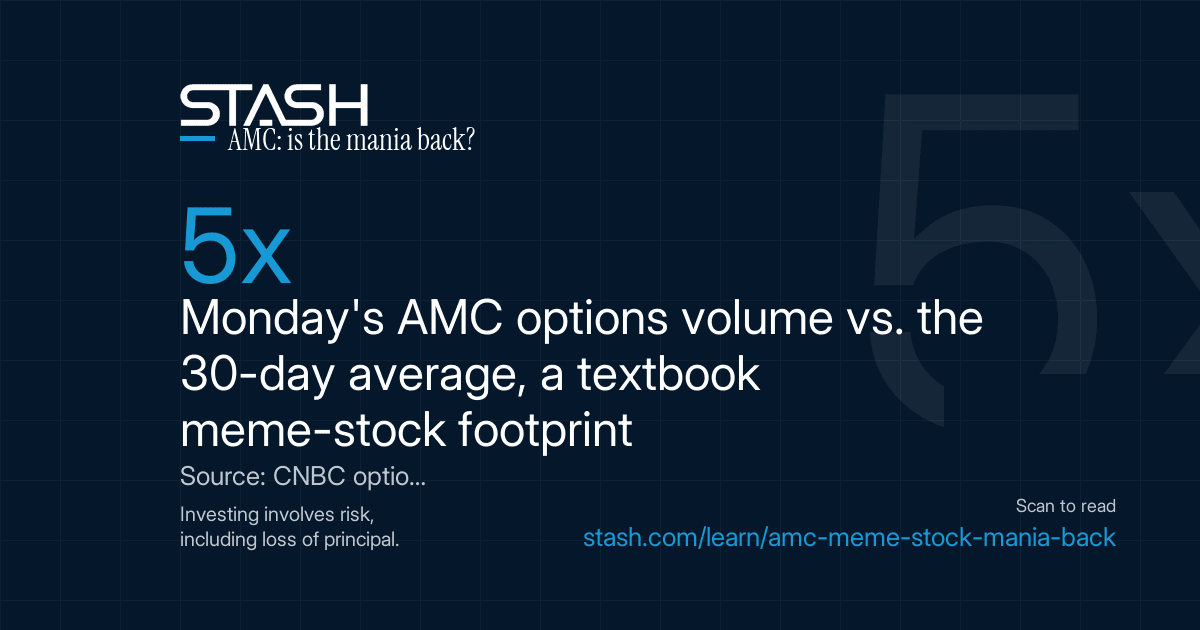
Options volume is the crowd's tell before the stock even moves. When call buying spikes to five times normal on a stock that already moved 27%, the retail energy is unmistakable. What separates 2026 from 2021 is what sits behind that energy.
This time the earnings are real, and The Odyssey is why
In 2021 the AMC rally was a short squeeze on a cash-burning company. In 2026 the same crowd showed up, but the numbers behind them changed. Revenue rose 14.2% to $1.596 billion, adjusted EBITDA jumped 70% to $321.4 million (both 106-year records), and adjusted diluted EPS came in at 14 cents against a six-cent consensus loss, per the Q2 8-K and Reuters via LSEG. Adjusted EBITDA margin expanded from 13.6% a year ago to 20.1%, and the company generated $190.1 million of free cash flow in the quarter with $778 million of cash on hand. Since the end of 2020, principal debt has come down by roughly $1.7 billion with no scheduled maturities until 2029, per CEO Adam Aron's remarks reported by Deadline.
The engine is Christopher Nolan's The Odyssey. It opened to $124.5 million domestically and $264.1 million globally in its first three days — Nolan's biggest worldwide debut ever and enough to recoup its $250 million budget almost immediately, per Variety and CNBC. AMC drew 4.3 million patrons across AMC and Odeon theaters over the opening weekend. The financial punch was even bigger than the attendance number suggests: premium large formats (IMAX, Dolby, and similar) sold 45% of Odyssey tickets at about $19 apiece, per EntTelligence via CNBC. IMAX alone drove $51.8 million in global weekend gross, about 23% of the film's global total from a small fraction of the screens, and locked in a four-week exclusive that blocks Spider-Man: Brand New Day from the format entirely, per Khaleej Times. Aron was blunt on the earnings call about the streaming war: "I think we've won that fight."
The number no one screenshots
Here is what almost no coverage puts on a card. AMC's split-adjusted all-time high was $726.20, hit on June 2, 2021, per WallStreetNumbers. At Monday's close of $2.46, $1,000 invested at that peak is worth about $3.40 today, a decline of roughly 99.7%. That is not a typo. Not $340. Not $34. Three dollars and change.
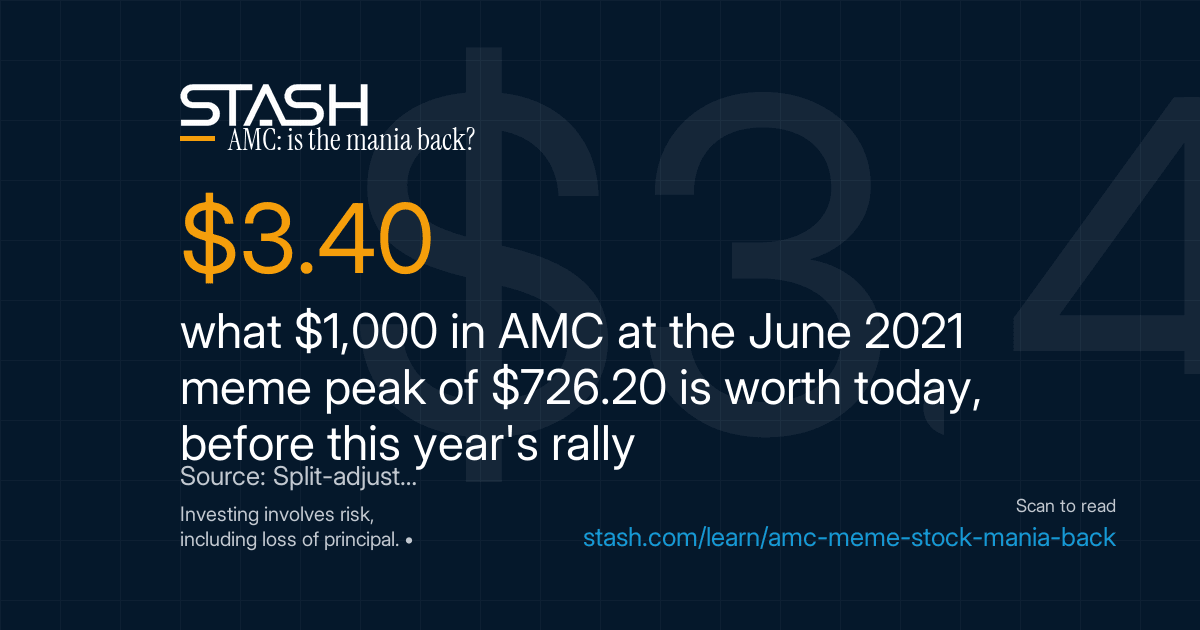
This example is a hypothetical illustration only, based on split-adjusted historical prices, and it is not a prediction about future performance. The point is not to shame anyone who bought in 2021. Millions of people did, and AMC disclosed roughly 4.1 million individual shareholders that year, more than 80% of them retail, per Benzinga's dilution post-mortem. The point is that even the best quarter in AMC's 106-year history has not undone the drawdown that followed the last mania. The math the last wave of apes learned the hard way is still the math today.
The reason it stayed the math is one number: dilution. AMC had roughly 501.8 million shares outstanding at the end of 2021. By January 2024, after multiple equity raises, the 2022 AMC Preferred Equity (APE) conversion, and a 1-for-10 reverse stock split, that count had grown to about 2.46 billion on a pre-split basis, per Benzinga. About 13 times more claims on the company than there were at the 2021 peak.
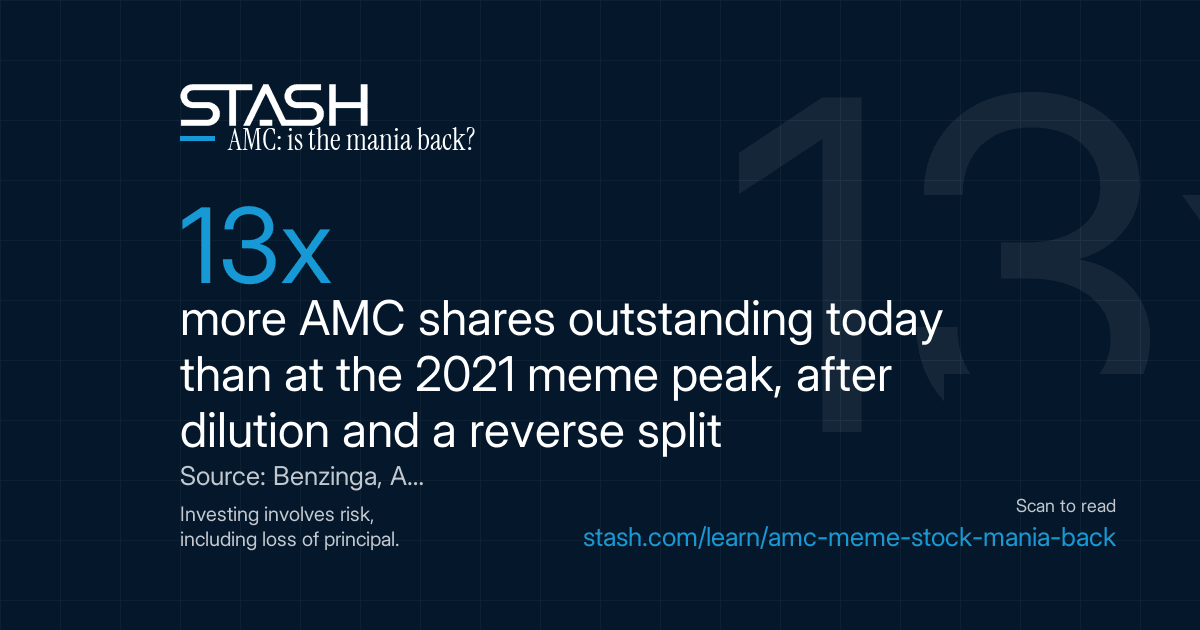
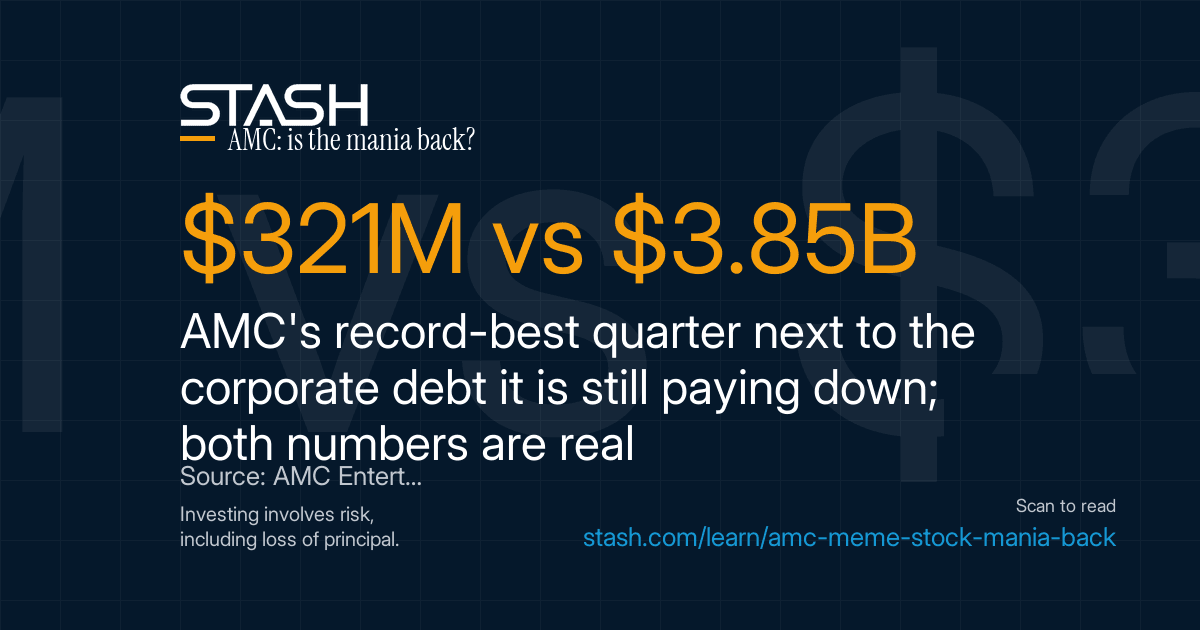
Dilution is what a company does when it needs cash and the stock is the cheapest thing it owns. Every share sold at inflated 2021 prices raised money for AMC and shrank the ownership share of everyone already in. On top of that, AMC still carries $3.85 billion in corporate borrowings and negative stockholders' equity of $1.45 billion, per its filings and Yahoo Finance. That is why a great quarter can still be a bad stock: a record $321 million in adjusted EBITDA has to serve a much bigger stack of shares and a still-substantial pile of debt before any of it flows to a shareholder.
The concentration hiding inside the win
Here is the wrinkle almost nobody flags. The record quarter itself is a concentration bet. Premium large formats sold 45% of Odyssey tickets, and IMAX alone drove 23% of the movie's global gross from a small slice of screens. Zoom out: IMAX generates about 5.2% of the entire North American domestic box office from less than 1% of the country's movie screens, per Forbes coverage of 2026 industry data. Premium formats overall are now 15.6% of North American ticket revenue.
That is impressive engineering. It is also concentration risk on top of concentration risk. AMC's quarter depended on a small number of premium auditoriums running a small number of big-swing films. Next quarter depends on Spider-Man: Brand New Day (opening July 31). Q4 depends on Dune: Part Three and Avengers: Doomsday. All three are films AMC and CEO Adam Aron have publicly named as the catalysts for the full-year outlook. If any of them slips or misses, the concentration cuts the other way. This is why a stock built on real earnings can still swing violently: the earnings themselves ride a narrow slate.
What we see from inside Stash: the crowd default is not a meme stock
Zoom out from AMC for a second. Over the 30 days ending July 14, 2026, the top five most-bought names on Stash by share of buy dollars were SpaceX (SPCX) at 8.3%, Stocks Nationwide (VTI) at 6.2%, Match the Market (IVV) at 4.2%, NVIDIA (NVDA) at 2.8%, and US Treasury Income (TFLO) at 2.7%, per Stash internal trading data. Six of the ten most-bought investments were diversified ETFs. Two were bond or Treasury funds. No AMC on the list.
That is the reframe. When the headlines are shouting about the mania, most people on Stash are quietly buying the basket. The crowd's default is not a meme stock. It is a diversified fund. That is not because meme stocks are wrong for everyone; it is because a fund does the sizing for you, and sizing is the whole game.
Here is what to actually do
Whether AMC is on your radar or you are watching the headlines from a distance, the point is not to guess the top or the bottom on a single ticker. It is to do what an advisor would do: know the story you are actually paying for, and size on purpose.
Name the story. Are you investing in a business (a theater chain with record EBITDA and $3.85 billion in debt) or reacting to a mood (a 27% pop and a meme narrative)? Both are legitimate. Only one gets you an advisor answer.
Pick a ceiling on any single name. There is no one right number, but no single stock should be able to sink your plan on its own. Meme stocks are exactly where that ceiling gets tested, so decide it before you buy, not after.
Size on purpose. If you want AMC exposure, add small and space it out with fractional shares and Auto-Stash rather than chasing a single-day move. If you would rather not manage it stock by stock, a diversified or managed portfolio spreads the bet for you.
None of this is a recommendation to buy, sell, or hold AMC. It is the conversation a financial advisor would walk you through, which is what Stash is built to be.
Doing it on Stash
If you have named the story and want to add in the right size, or trim back to it:
Add small with fractional shares. Search AMC and pick a dollar amount, so a volatile stock does not require the price of a full share to get exposure.
Average in with Auto-Stash. Schedule small recurring buys to spread your entry over time rather than chasing after a 27% pop.
Prefer not to pick? A diversified or managed portfolio keeps the sizing decision from being yours to make one ticker at a time.
None of this is a recommendation to buy, sell, or add to AMC. How much of any one stock fits your portfolio depends on your own situation.
FAQ: AMC meme stock questions
Is AMC still a meme stock in 2026?
By behavior, yes. Monday saw more than 300,000 AMC options contracts trade, five times the 30-day average, with a put/call ratio of 0.27 — all textbook meme-stock signals, per CNBC. By fundamentals, the setup has changed: AMC posted the biggest quarterly revenue ($1.6 billion) and adjusted EBITDA ($321.4 million) in its 106-year history, per its Q2 2026 earnings release. It is a meme stock trading with real earnings behind it for the first time since 2021.
Why did AMC stock jump 27% on July 20?
Two things landed on the same morning: AMC's Q2 2026 earnings, which set a 106-year revenue and EBITDA record and beat consensus on adjusted EPS (14 cents versus a six-cent loss expected), and the $264.1 million global opening weekend of Christopher Nolan's The Odyssey, per AMC's press release and Variety.
How is this AMC rally different from 2021?
The 2021 rally was a short squeeze on a cash-burning company. The 2026 rally has real fundamentals underneath it: record revenue, record adjusted EBITDA, positive free cash flow, and $778 million of cash on hand. What has not changed is the balance sheet: AMC still carries $3.85 billion in corporate borrowings and negative stockholders' equity of $1.45 billion, and the share count is roughly 13 times what it was at the 2021 peak, per Benzinga's dilution timeline.
What was AMC stock's all-time high?
$726.20, on June 2, 2021, on a split-adjusted basis, per WallStreetNumbers. Before the August 2023 1-for-10 reverse split, that number appears in older records as $72.62. Either way, the stock is currently down about 99.7% from that peak.
Should I invest in AMC right now?
This is general guidance, not personalized advice. The useful frame is not buy or sell, it is sizing. Decide the ceiling for any single stock in your plan and let that discipline drive the decision, not a 27% one-day move. A stock that moved 27% in one direction can move 27% in the other one.
Can I invest in AMC on Stash?
Yes. AMC (NYSE: AMC) trades publicly, so you can invest in it on Stash like any other listed stock, including fractional shares from any dollar amount and Auto-Stash for scheduled recurring buys.
Related reading
What Is Diversification?
Bottom line
The apes are back, and this time they brought earnings. But a 27% pop on a Monday is a headline, not a plan. Know the story you are actually paying for, pick a ceiling on any one name, and size on purpose. Headlines are loud; your process can be quiet.
Important disclosures
Investing involves risk, including the possible loss of principal. Past performance is not a guarantee of future results.
This article is for educational purposes only and is not a recommendation to buy, sell, or hold any security, including AMC.
This is a hypothetical illustration of how market volatility and percentage fluctuations can impact the value of a single-name investment. Actual results will vary due to market conditions, volatility, taxes, fees, and subscription costs. This example is for general illustrative and educational purposes only and is not indicative of the future performance of any actual investment or investment strategy. All investments involve risk, including possible loss of principal.
The historical return example (the $1,000-at-the-2021-peak figure) is based on the split-adjusted all-time closing high of $726.20 on June 2, 2021 as reported by WallStreetNumbers, and the July 20, 2026 close of $2.46 as reported by Yahoo Finance. It reflects price change only, does not include dividends, fees, or taxes, and changes as the stock price moves. It is not a prediction of future results.
The dilution figure (roughly 13 times more shares today than at the 2021 peak) is based on publicly reported share counts of about 501.8 million at the end of 2021 and about 2.46 billion on a pre-split basis as of January 2024 per Benzinga and AMC filings. It reflects one point-in-time comparison; the outstanding share count changes over time with any subsequent equity issuance, repurchase, or corporate action.
Prices, valuations, options figures, and analyst views cited reflect publicly reported information as of July 20, 2026 and change over time.
Options trading involves risk and is not suitable for all investors. Stash does not offer options trading.
Reverse-split and equity-offering references are historical and are not a recommendation to invest in any offering. AMC's 2022 APE distribution, 2023 APE-to-common conversion, and August 2023 1-for-10 reverse stock split are historical corporate actions reflected here for context only.
Diversification and dollar-cost averaging do not ensure a profit or protect against loss.
Stash offers access to investment and other accounts for a monthly subscription fee; current plan pricing is described at stash.com. Other fees may apply; see the fee schedule for details. Fees reduce your returns.
This article summarizes publicly reported company financial results for context only. It is not a recommendation regarding any security and is not a solicitation or offer to buy or sell any security.
Stash does not provide tax or legal guidance. Consult a qualified tax or legal professional about your own circumstances.
This material reflects general information, not individualized financial, legal, or tax guidance. Stash is a registered investment adviser; what is right for you depends on your specific situation.
Stash trading statistics reflect aggregate Stash customer activity: share of buy and sell dollars on Stash over the 30 days ending July 14, 2026. They describe past customer behavior, are not investment advice, and are not a recommendation to buy, sell, or hold any security.
Educational only and does not constitute investment, legal, accounting, or tax advice. See full disclosures at www.stash.com/disclosures.

Written by
Team Stash
We want to turn money into a source of hope and opportunity. We teach people how to build good habits, save more and make it easy and affordable to get started investing. So far, we’ve helped over 6 million people create a more secure financial future with our expert advice and award winning investing app.
Related articles
financial-news
Jul 27, 2026
LeBron's NBA salary just went from ~$52.8M to ~$3.9M. His wealth didn't. Here's the money lesson.

financial-news
Jul 27, 2026
Your Money Headlines this Week
financial-news
Jul 21, 2026
AMC had its biggest quarter in 106 years. The stock is still down 99%. Both are true.
financial-news
Jul 21, 2026
Who Makes Money From the World Cup? Follow the Cash
financial-news
Jul 09, 2026
You already own NVIDIA (yes, you). Here's how much.
financial-news
Jul 01, 2026
Bitcoin's Worst Month in Years: What It Means for You

By using this website you agree to our Terms of Use and Privacy Policy. To begin investing on Stash, you must be approved from an account verification perspective and open a brokerage account.