What a SpaceX IPO Could Mean for Everyday Investors
Published: Jun 03, 2026
In this article:
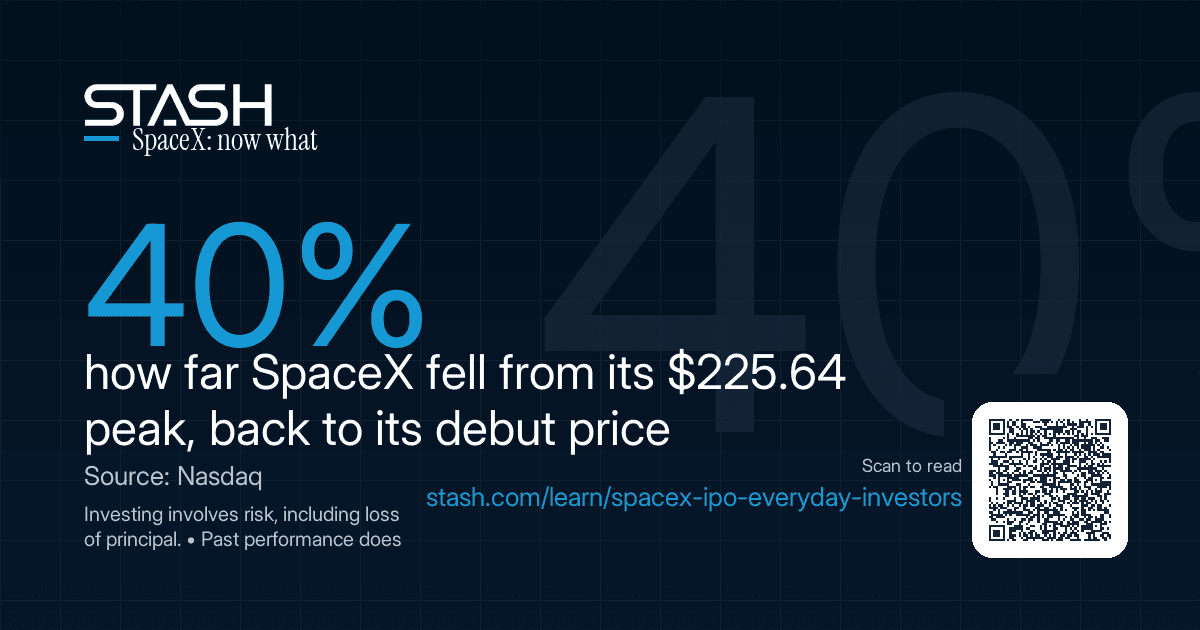
The SpaceX pop is over. SPCX has round-tripped its entire post-IPO run, down about 40% from its peak, according to Nasdaq trading data. Since its June 12, 2026 debut the stock ran from a $135 IPO price to an intraday high of $225.64, then slid all the way back to around $136, essentially its IPO price.
Send this to anyone who texted you "should I buy SpaceX?" or "should I sell my SpaceX?" this week. If you got a few shares, or bought after the open and you're now underwater, here is the calm, honest answer, with the numbers behind it.
First, know where you actually stand, because "SpaceX is down" means different things for different buyers. If you were one of the few who got the $135 IPO allocation, you're about breakeven, barely above where you started at around $136. If you bought once trading opened, you paid $150 or more and you're underwater, and anyone who chased the $176 to $225 spike is sitting on a real loss. Same stock, very different position. The pop rewarded early allocation and punished the chase.
What actually happened
SpaceX priced the largest IPO in history at $135 a share, raised roughly $75 billion, opened at $150, and briefly touched $225.64 intraday as demand overwhelmed a tiny supply of shares. Then reality set in. By mid-July the stock had round-tripped all the way back to its debut price, giving back essentially all of its post-IPO gains even after joining the Nasdaq-100 on July 7, the fastest a newly public company has ever entered the index.
The setup explains both the spike and the fade. SpaceX floated only about 4.3% of its shares, so a flood of buyers chased a sliver of supply, the classic recipe for a violent first-day jump. That same thin float now cuts the other way: with so few shares trading, sentiment swings move the price hard, and as staggered lockups expire over the coming months, more shares reach the market and change the supply-demand picture that drove day one.
The allocation lottery
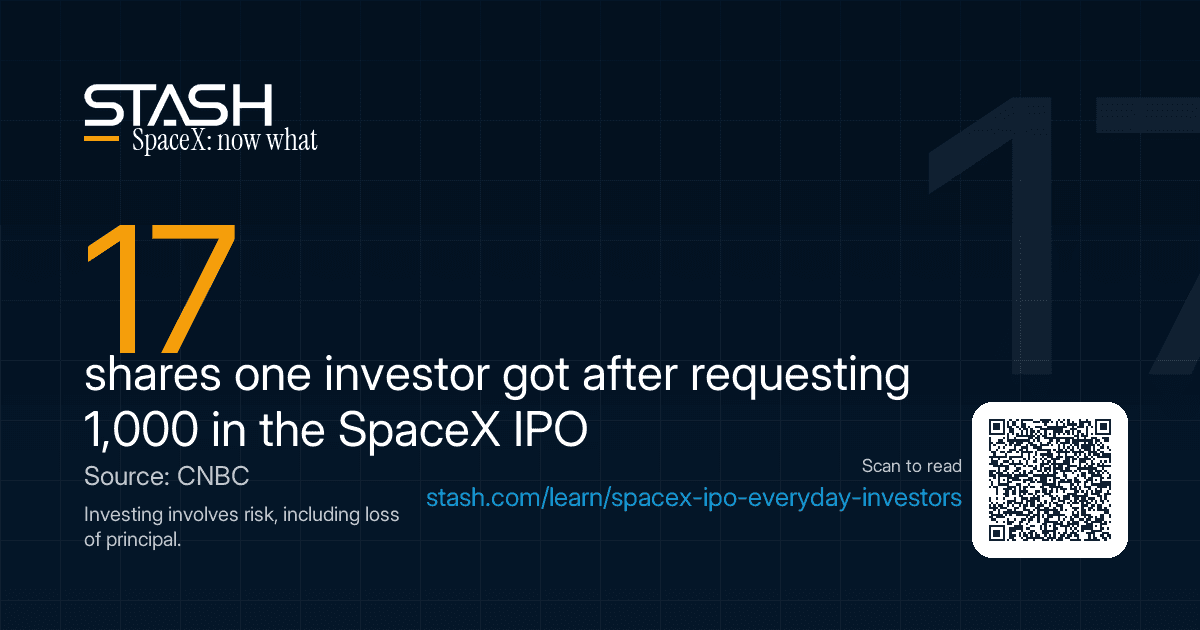
Demand was so far beyond supply that most retail investors who asked for shares at $135 got a fraction of what they wanted. On forums like WallStreetBets, people posted screenshots of single-share allocations after requesting hundreds. One investor told CNBC he requested 1,000 shares through his brokerage and was allocated 17.
That tiny allocation felt like a snub in June. In hindsight, getting fewer shares at $135, or none at all, spared a lot of people from buying the top at $200-plus. A missed allocation is not a missed fortune.
So you're holding SPCX. Now what?
The honest answer: whether you got 17 shares or bought 3 after the open, the decision is the same one every investor faces with any stock. It comes down to why you own it and how much of your money is riding on it, not what it did last week.
Three questions to work through before you touch the sell button, or the buy button:
How big is the position? Add it up. If SPCX is a small slice of a diversified portfolio, the day-to-day swings are noise you can afford to ignore. If one hot stock has quietly become 15% or 20% of your money, that is concentration risk, and it can hurt a lot on a stock this volatile, regardless of the entry price.
Why did you buy it? If the reason was "it's SpaceX and it was going up," that was a reaction, not a plan. If you actually believe in the business over five to ten years and sized it accordingly, a rough three weeks does not change the thesis.
What would make you sell? Decide the rule before the emotion. Selling only because it dropped locks in the loss and often means buying back higher later. Selling to right-size an oversized position is a plan. Panic is not.
None of this is a recommendation to buy, sell, or hold SPCX. It is the conversation an advisor would walk you through, which is exactly what Stash is built to be.
Why chasing a hot IPO is so tempting, and so risky
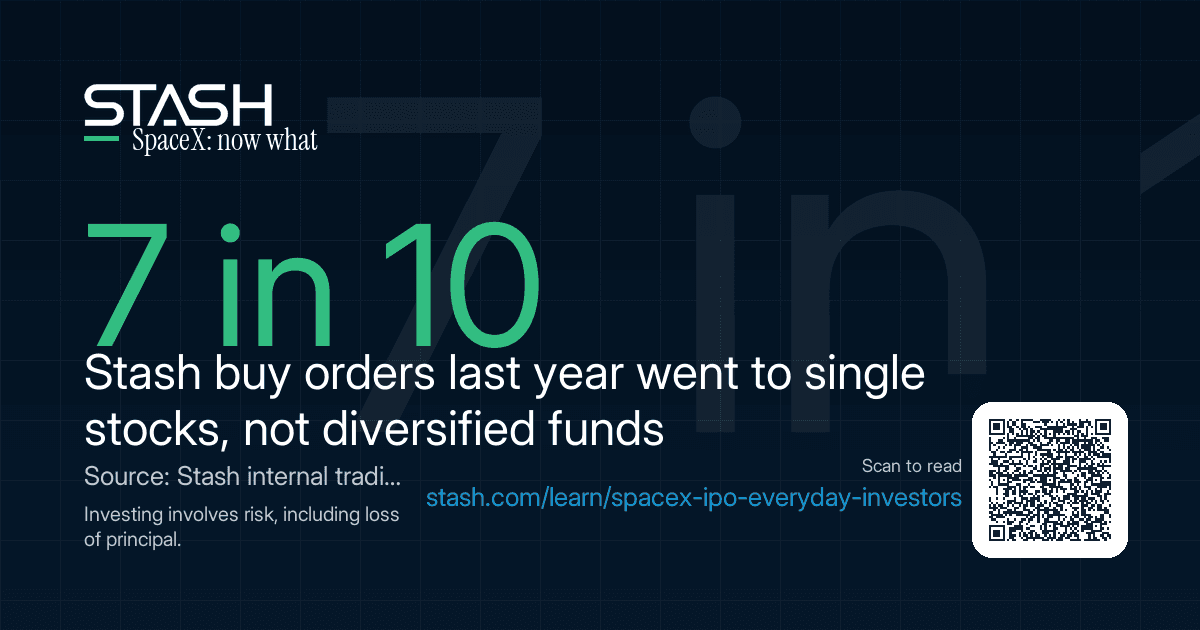
Here is something we can see from inside Stash that most coverage can't. Over the past year, about 7 in 10 stock and ETF buy orders on Stash were for single stocks rather than diversified funds. The pull toward one exciting name is strong, and a record IPO pulls hardest of all.
Look at the last buzzy IPO retail investors piled into. Since Reddit (RDDT) went public in 2024, Stash investors have placed nearly as many sell orders as buy orders in it, roughly 9 sells for every 10 buys. That is a lot of trading in and out of one hot stock, which looks more like reacting to headlines than building a portfolio. The pattern is the point: a hot name invites churn, and churn is not a plan.
A quick portfolio example. Say you have $10,000 across broad funds and a few individual stocks, and you put $2,000 into one hot stock because it felt like a rare opportunity. Now 20% of your portfolio rides on one company. If that stock drops 40%, your overall portfolio loses 8% from that position alone, even if everything else holds flat. That is concentration risk, and it sneaks in fast on a stock that swung from $150 to $225 and back below $140 in a matter of weeks. This example is hypothetical and is not a forecast for SpaceX or any other stock.
The valuation debate is still live
A famous company can still be an expensive stock. Even after the pullback, analysts disagree sharply on what SpaceX is worth. Morningstar argues the shares remain overvalued and could be worth less than half the IPO price, pointing to years of heavy spending on Starlink, Starship, and AI infrastructure before profits catch up. Several underwriting banks kept Buy ratings with targets above the current price. That spread, from a "sell" call to bullish targets, tells you the market has not agreed on a fair value, which is one more reason to keep any single position modest.
The business is what you own now, not the first-day headline. If you want to judge it, the prospectus is where the real information lives. Pay attention to:
Revenue sources: how much comes from launches, Starlink, government and defense contracts, and AI infrastructure. Starlink is the largest driver today.
Profitability: the filing shows operating losses, so look at whether the path to profit is credible.
Cash needs: space, satellite, and AI businesses require huge ongoing investment.
Float and lockups: only about 4.3% of shares were floated, and staggered lockups release more supply over the coming months.
Voting rights: a dual-class structure leaves Musk with the large majority of voting power, so public shareholders have limited say.
How to buy (or add to) SPCX on Stash
If your answer to the three questions is "I want to own this for the long haul, in the right size," here is how to do it without trying to time a volatile stock:
Search SPCX in the app and choose a dollar amount. With fractional shares you can invest a few dollars at a time, so a $136 stock doesn't require a $136 minimum.
Dollar-cost average with Auto-Stash. Schedule small recurring buys and average in over time instead of guessing the bottom. On a stock this volatile, spreading entries out beats betting on one perfect moment.
Keep it in proportion. A single stock can be one slice of a diversified portfolio. Stash plans start at $3 a month, and the whole idea is a financial advisor in your pocket helping you decide how much one company should be.
One distinction worth keeping straight: the $135 IPO price was a one-time allocation that mostly went to large institutions before trading began. Stash does not offer IPO allocations. What you can do now is buy SPCX at the market price, which can be higher or lower than $135, like any investor buying after the open.
SpaceX vs. Starlink
Many searches for "SpaceX stock" are really about Starlink, SpaceX's satellite internet business. They are related, but they are not the same investment. Buying SPCX gives you exposure to the whole company: launch services, Starlink, government and defense contracts, spacecraft, and AI infrastructure. Starlink is the largest revenue source, but it is not a separately traded stock. There is no separate Starlink stock to buy today.
FAQ: SpaceX stock questions
I'm down on SpaceX. Should I sell?
That depends on why you own it and how big the position is, not on the recent drop alone. Selling only because the price fell locks in the loss and often leads to buying back higher. If SPCX has become an oversized share of your portfolio, trimming to right-size it is reasonable. This is general guidance, not a personalized recommendation.
I only got a couple of shares. Is it worth holding?
A small position is easy to hold through volatility precisely because it's small. The question is the same as for any holding: do you believe in the business long term, and is the size right for your plan? A few shares of one stock inside a diversified portfolio is very different from a concentrated bet.
Is SpaceX still above its IPO price?
As of mid-July 2026, SPCX traded around $136, just above its $135 IPO price and far below both its $150-plus opening level and its $225.64 intraday peak. So IPO allocation holders are about breakeven, while many who bought after the open are underwater.
Why is the stock so volatile?
Only about 4.3% of SpaceX's shares are freely traded. With such a thin float, buying and selling pressure moves the price sharply, and staggered lockups will add more shares over time.
Can I buy SpaceX stock on Stash?
Yes. Now that SPCX trades publicly, you can buy it on Stash like any other listed stock, including fractional shares so you can start small and dollar-cost average. Stash does not offer IPO allocations at the offer price.
Is Starlink stock available to buy?
No. Starlink is part of SpaceX, not a separately traded public stock, so buying SPCX is an investment in the whole company.
Related reading
Bottom line
A nearly $1.8 trillion rocket company is still just one stock, so own it like one: a small slice of a diversified, long-term plan. The pop is gone, and that is not a reason to panic-sell or a reason to pile in. Decide how much SPCX belongs in your portfolio, size it there, and let the daily swings be someone else's stress. The headline was loud; your process can be quiet.
Important disclosures
Investing involves risk, including the possible loss of principal. Past performance is not a guarantee of future results.
This article is for educational purposes only and is not a recommendation to buy, sell, or hold any security, including SPCX.
Any hypothetical example is for illustration only. It is not a prediction or guarantee of performance, does not reflect actual results, and does not account for fees, taxes, or other costs.
IPOs and newly listed stocks can be highly volatile and involve significant risk. Availability through any particular brokerage is not guaranteed, and Stash does not offer access to IPO allocations.
Prices, valuations, index membership, and analyst views cited reflect publicly reported information as of mid-July 2026 and change over time.
Stash does not provide tax or legal guidance. Consult a qualified tax or legal professional about your own circumstances.
This material reflects general information, not individualized financial, legal, or tax guidance. Stash is a registered investment adviser; what is right for you depends on your specific situation.
Stash trading statistics reflect aggregate Stash customer activity: single-stock versus fund buy orders over the trailing 12 months ending June 2026, and cumulative Reddit (RDDT) buy and sell orders since its March 2024 listing. They describe past customer behavior, are not investment advice, and are not a recommendation to buy, sell, or hold any security.

Written by
Team Stash
We want to turn money into a source of hope and opportunity. We teach people how to build good habits, save more and make it easy and affordable to get started investing. So far, we’ve helped over 6 million people create a more secure financial future with our expert advice and award winning investing app.
Related articles
financial-news
Jul 27, 2026
LeBron's NBA salary just went from ~$52.8M to ~$3.9M. His wealth didn't. Here's the money lesson.
financial-news
Jul 27, 2026
Your Money Headlines this Week
financial-news
Jul 21, 2026
AMC had its biggest quarter in 106 years. The stock is still down 99%. Both are true.
financial-news
Jul 21, 2026
Who Makes Money From the World Cup? Follow the Cash
financial-news
Jul 09, 2026
You already own NVIDIA (yes, you). Here's how much.
financial-news
Jul 01, 2026
Bitcoin's Worst Month in Years: What It Means for You

By using this website you agree to our Terms of Use and Privacy Policy. To begin investing on Stash, you must be approved from an account verification perspective and open a brokerage account.