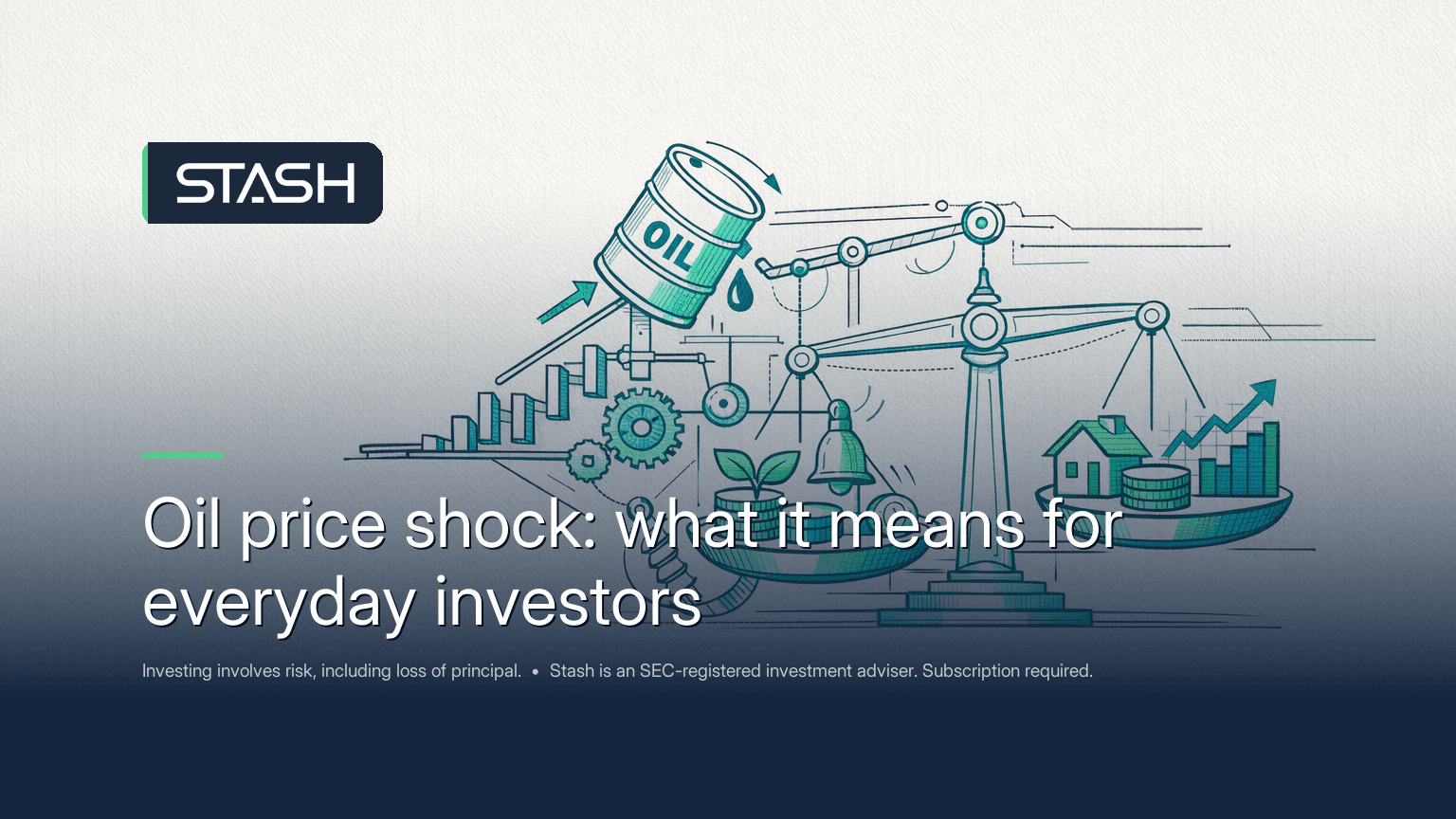
Oil price shock: what it means for everyday investors
Published: Jun 10, 2026
• Updated: Jun 18, 2026
In this article:
- What happened
- Angle 1: Oil prices can show up in inflation fast
- Angle 2: Rate expectations can change before rates do
- Angle 3: Company costs can move the market unevenly
- Historical context: oil shocks fade, but not on your schedule
- The durable lesson: diversification is built for messy weeks
- 5 companies that could be impacted
- Bottom line
- Important disclosures
- Frequently asked questions
By Ed Robinson, Co-Founder & Co-CEO, Stash · FINRA Series 7 & 63 · Graduate Diploma in Financial Planning · Last updated June 15, 2026
Brent crude fell about 4% to roughly $83.75 a barrel Monday, its lowest level since March, after the United States and Iran reached an initial deal over the weekend to end their conflict and reopen the Strait of Hormuz. That number matters because it shows how fast an oil story can swing in both directions.
The surprising angle is not that prices fell. It is that one supply route can touch your gas bill, grocery prices, Fed expectations, company profits, and your portfolio all at once, on the way up and on the way back down.
If you are searching for this, you are already doing the right work: reading market news as a signal, not a command. For a broader playbook, start with The Stash Way: Invest Regularly.
What happened
Over the weekend, President Trump announced an initial agreement with Iran to end nearly four months of conflict, saying the deal with Iran was complete. A signing ceremony is expected Friday in Switzerland, opening a 60-day window for talks over Iran's nuclear program. Trump said vessels would be able to pass through the Strait of Hormuz toll free and that the U.S. naval blockade would be lifted.
That reverses the supply shock that had gripped energy markets. The Strait of Hormuz had been effectively closed since early March 2026, for roughly three months, because vessel insurance was unavailable or too costly and crews were unwilling to transit. Roughly 20% of the world's seaborne oil and major liquefied natural gas volumes normally pass through that waterway. The International Energy Agency had called the disruption the largest supply shock in global oil market history. Brent topped $100 a barrel on March 8 for the first time in four years, then peaked around $126 to $140 before easing toward the mid-$90s.
Markets moved fast on the news. Brent crude fell 4.1% to about $83.75 a barrel and U.S. crude dropped 4.7% to around $80.87, both the lowest since March 10. Stocks rallied: Japan's Nikkei 225 jumped 5.4% to a record 69,603.91, and S&P 500 futures pointed up about 1%.
But a deal is not the same as oil flowing freely again. Roughly 600 commercial vessels are waiting to transit. Restarting about 10,000 wells and roughly 15% of the world's production after about 100 days offline has no clear playbook, and analysts expect a controlled ramp-up over several weeks to months. Saudi Aramco's chief executive has warned that stability may not return until 2027, and the International Monetary Fund cautioned that reopening will not bring instant relief. Futures still price oil above pre-conflict levels at year-end.
This is not personalized advice. It is general guidance; what's right for you depends on your specific situation.
Angle 1: Oil prices can show up in inflation fast
Oil is not just what goes into your car. It helps move food, packages, building materials, airline passengers, and factory goods. When crude prices rise, transportation costs can rise too. That can show up later in prices you see at the pump, at the grocery store, or in shipping fees.
That chain is exactly what just played out. The annual rate of U.S. inflation hit 4.2% in May, its highest in three years, as higher transportation costs from the energy shock passed through to consumers. The hope now is that a deal marks the peak. But the same logic works in reverse and on a delay: lower crude takes time to filter into prices, and energy relief alone may ease inflation only gradually.
Here is a real-life version. You commute 35 minutes to work, buy groceries every Sunday, and book one flight to see family this summer. Higher oil prices touched all three this spring. Cheaper oil can ease them, but probably not overnight.
The key word is still "can." Strategic reserve releases, higher U.S. exports, waivers on Russian crude, and softer Chinese demand had already cushioned the shock before the deal. Now the question is how fast supply actually returns.
Angle 2: Rate expectations can change before rates do
The Federal Reserve does not set oil prices. But it does watch inflation. As the conflict threatened to keep inflation hot, markets had moved toward pricing in a Fed rate hike, with the odds of an increase by the end of 2026 climbing above 60%.
The deal changes that math. With energy fears easing, the Fed is now widely expected to hold rates steady at its meeting this week rather than hike. That said, a return to near-term rate cuts still looks unlikely: inflation is running well above target, growth is resilient, and a full normalization of oil supply is not yet priced in.
This is why one oil headline can move tech stocks, even when a software company does not buy much crude. It is not always about the company's direct fuel bill. It can be about the discount rate investors use to value future earnings.
For everyday investors, this is the chain to watch: oil move, inflation expectations, rate expectations, stock and bond prices. The chain runs both ways. If you want more context on that middle step, read What Is a Roth IRA?.
Angle 3: Company costs can move the market unevenly
Oil moves do not hit every company the same way. As prices fell on the deal, energy producers gave back ground while airlines and other fuel-sensitive names, which had been squeezed by high jet fuel, rallied. Some energy producers benefit from higher prices; shippers, chemical makers, restaurants, and airlines often benefit when prices fall. Some companies can pass costs to customers. Others have to absorb them.
That is why index-level moves can hide a lot. One day the market is "up," but under the surface, some sectors are gaining while others give back months of outperformance. That does not mean you need to trade every sector headline. It means you can read the market with more detail.
Think of a family budget. If gas falls, you might add one restaurant meal, or take the trip you delayed. Companies make similar choices at a larger scale, and they react to both the rise and the relief.
Portfolio volatility can rise when investors do not know how fast supply returns or whether the ceasefire holds. Markets dislike uncertainty, and a controlled reopening still carries plenty of it.
Historical context: oil shocks fade, but not on your schedule
Oil shocks have happened before. In 1973, the Arab oil embargo helped push energy prices sharply higher, and Federal Reserve History notes that it added to a painful inflation and recession period in the U.S. In 1990, Iraq's invasion of Kuwait sent oil prices up before they later fell as the Gulf War moved quickly.
More recently, Russia's invasion of Ukraine in 2022 pushed energy markets into turmoil. The U.S. Energy Information Administration reported that crude prices surged in early 2022 as sanctions, supply concerns, and war risk changed global trade flows.
The lesson is not that every oil shock ends the same way. They do not. Some last weeks. Some reshape trade routes for years. This one spiked above $140, then reversed hard on a single weekend headline.
The lesson is that markets often react before the full economic story is clear. Prices may swing on fear, then swing again as supply responds, demand weakens, or policy changes. That is why one dramatic week can feel bigger than it later looks on a long-term chart, and why a relief rally can overshoot too.
This is also where market labels can confuse people. A sharp drop, or a sharp recovery, does not always mean a lasting trend. If you want to separate a selloff from a deeper cycle, read Stash Learn and What is a bull market?.
The durable lesson: diversification is built for messy weeks
A geopolitical oil shock, and its sudden resolution, is a good test of your investing process. If your plan only works when headlines are calm, it may be too fragile. Diversification exists because the next swing is hard to predict in either direction.
Diversification does not stop losses. It does not promise smoother returns every week. It spreads your exposure across different areas so one event, sector, or company does not carry the whole load.
That matters because the first headline is rarely the whole story. In this episode, prices spiked above $100, rose much higher, eased toward the mid-$90s, then dropped to the low $80s on a deal. If you made every decision from the scariest headline, you may have missed the next phase. If you chase the relief rally, the gradual reopening may still surprise you.
A long-term investor can ask different questions than a day trader:
Is my portfolio too tied to one sector, country, or theme?
Do I have enough cash set aside for near-term needs?
Am I reacting to price moves, or updating my view based on facts?
Does this news change my time horizon, or just my mood?
Those questions are more useful than trying to guess next week's oil price. They keep the focus on risk, time, and balance.
Stash is a regulated investment adviser — not a bank. The Stash plan can give you financial guidance built into your phone, but the point is not to chase headlines. The point is to understand what the headlines may mean for your money.
Frequently asked questions
Why do oil prices affect the stock market?
Oil prices affect the stock market because energy is a major cost for transportation, manufacturing, farming, and travel. Higher oil prices can raise company costs and consumer prices, while falling prices can ease them. That can move profits and change how investors value stocks.
Can an oil shock cause inflation?
An oil shock can add to inflation if higher energy costs spread into goods, services, and wages. U.S. inflation reached 4.2% in May during this episode. As prices fall, that pressure can ease, but usually on a delay rather than all at once.
What does the Strait of Hormuz have to do with my portfolio?
The Strait of Hormuz is a key route for global energy shipments, carrying roughly a fifth of the world's seaborne oil. When it is blocked, supply tightens and prices rise; when it reopens, supply can loosen. Either way it can affect inflation, interest-rate expectations, company costs, and market volatility.
Does a falling oil price mean I should change my investments?
Not based on the headline alone. This is general guidance, not personalized recommendations. A better first step is to review your goals, time horizon, cash needs, and diversification before making any investment decision.
How can Stash help me understand market news?
Stash provides general financial guidance through an app experience, not stock tips. Stash is a regulated investment adviser — not a bank. The goal is to help you connect news events to core money concepts like risk, diversification, and time horizon.
5 companies that could be impacted
Exxon Mobil (XOM) - Global crude price changes and Middle East supply shifts are directly relevant to its oil and gas production, refining, and trading operations.
Chevron (CVX) - Crude price movements and changing global supply affect its upstream oil production and integrated energy operations.
ConocoPhillips (COP) - As a large oil and gas producer, its revenue is closely tied to benchmark crude and natural gas prices.
Marathon Petroleum (MPC) - Oil price volatility affects its crude feedstock costs and refining margins.
Delta Air Lines (DAL) - Falling crude oil prices can lower jet fuel costs, a major operating expense for airlines.


Bottom line
An oil-price shock can ripple through inflation, rates, company costs, and market mood, and so can its resolution. A weekend deal can reverse months of price gains in a day, but reopening a closed shipping route takes longer than a headline. Read the news, understand the chain reaction in both directions, and keep your plan grounded in your own time horizon and risk needs.
Important disclosures
Investing involves risk, including possible loss of principal. This article is for education only and is not personalized investment, legal, or tax advice. Stash does not recommend that you buy or sell any specific security based on this news event.
Market indexes are unmanaged and cannot be invested in directly. Past market events do not predict future results. Oil prices, interest rates, inflation, and stock prices can change quickly.
Investing involves risk, including the possible loss of principal. See full disclosures at www.stash.com/disclosures.
Educational only and is not a recommendation to buy, sell, or hold any security. See full disclosures at www.stash.com/disclosures.
Stash is not a bank. Banking services are provided by a partner bank, and FDIC insurance is provided through that partner bank.
Educational only and does not constitute investment, legal, accounting, or tax advice. See full disclosures at www.stash.com/disclosures.
Find this useful? Send it to someone who needs it:

Written by
Team Stash
We want to turn money into a source of hope and opportunity. We teach people how to build good habits, save more and make it easy and affordable to get started investing. So far, we’ve helped over 6 million people create a more secure financial future with our expert advice and award winning investing app.
Related articles
financial-news
Jul 27, 2026
LeBron's NBA salary just went from ~$52.8M to ~$3.9M. His wealth didn't. Here's the money lesson.
financial-news
Jul 27, 2026
Your Money Headlines this Week
financial-news
Jul 21, 2026
AMC had its biggest quarter in 106 years. The stock is still down 99%. Both are true.
financial-news
Jul 21, 2026
Who Makes Money From the World Cup? Follow the Cash
financial-news
Jul 09, 2026
You already own NVIDIA (yes, you). Here's how much.
financial-news
Jul 01, 2026
Bitcoin's Worst Month in Years: What It Means for You

By using this website you agree to our Terms of Use and Privacy Policy. To begin investing on Stash, you must be approved from an account verification perspective and open a brokerage account.