Knicks Finals Boom: What $465M Really Means for NYC
Published: Jun 11, 2026
• Updated: Jun 18, 2026
In this article:
- What happened
- Angle 1: Revenue is not the same as profit
- Angle 2: Ripple effects are real, but uneven
- Angle 3: Investors need a bridge from event to earnings
- Historical context
- The durable lesson
- 3 companies that could be impacted
- Explore these on Stash
- Bottom line
- Important disclosures
- Frequently asked questions
By Ed Robinson, Co-Founder & Co-CEO, Stash · FINRA Series 7 & 63 · Graduate Diploma in Financial Planning · Last updated June 11, 2026
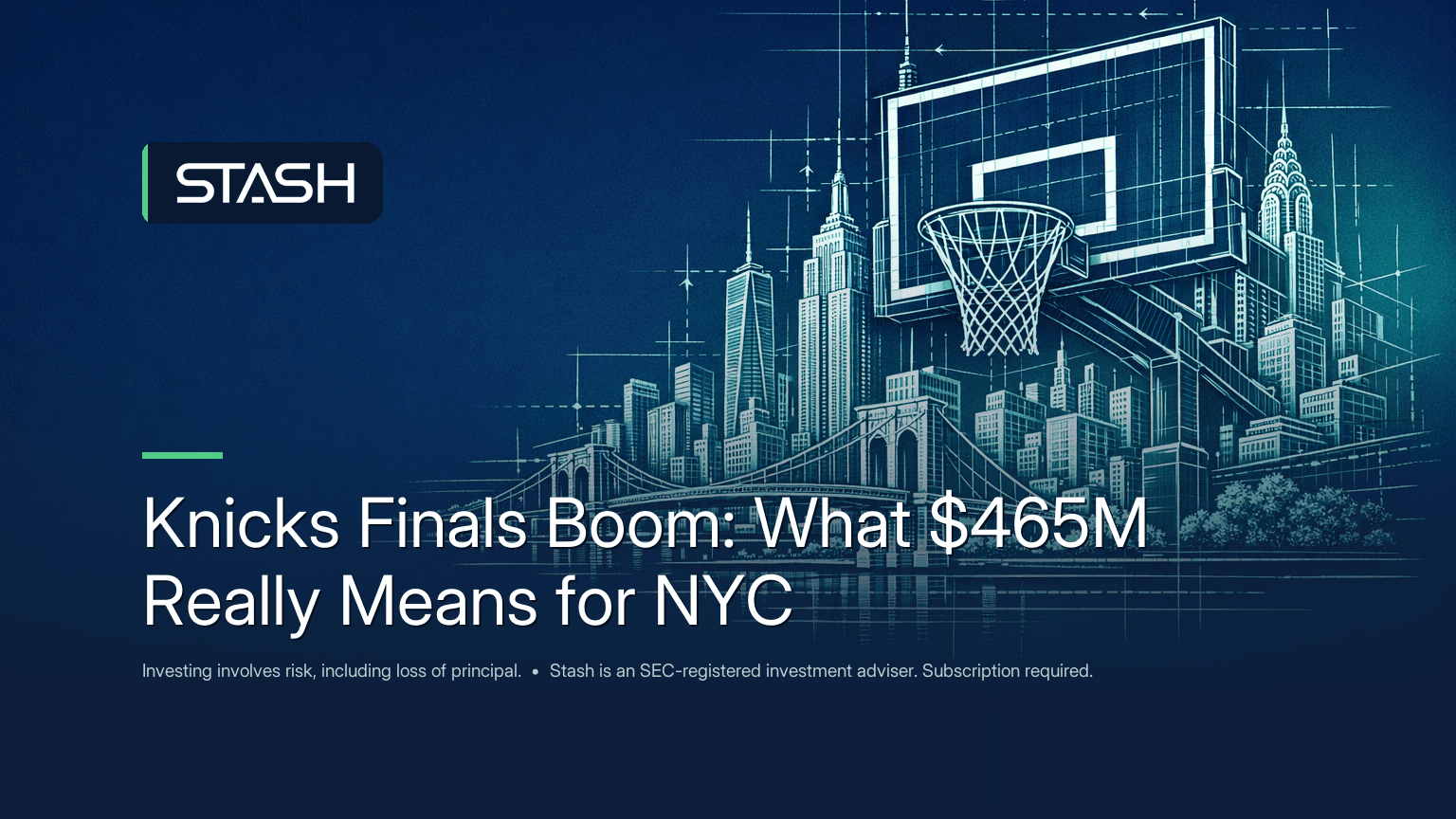
$465 million is the number attached to the Knicks’ NBA Finals run, according to Mayor Zohran Mamdani’s office. The bigger lesson is not that New York bars are packed. It is that headline spending estimates can sound more certain than they are.
CBS New York’s Alice Gainer reported that the city’s estimate depends on the series coming back to Madison Square Garden for Game 6. That detail matters. A sports boom can help restaurants, bars, hotels, rideshare drivers, merch sellers, and security firms for a few big nights. But short-term revenue is not the same thing as lasting business growth.
If you are reading market news through this lens, you are already doing the right work. For a broader framework, start with The Stash Way: Invest Regularly. This is general guidance; what's right for you depends on your specific situation.
What happened
CBS New York reported that Madison Square Garden was preparing for Game 3 on Monday and Game 4 on Wednesday, with the Knicks leading the Spurs 2-0 at the time of the report. A sweep was possible, but the city’s larger economic impact estimate was based on a longer series that could bring more home games to New York.
The numbers were eye-catching. CBS New York said Game 3 ticket prices on StubHub ranged from $5,200 to $329,000 in the hours before tip-off. The report also said bars and restaurants across New York had been at capacity during Knicks playoff games.
That is easy to feel if you live near the Garden. Your usual after-work spot has a line out the door. A pizza shop needs extra staff. A bar adds security. A fan who might spend $60 on a normal night may spend far more on tickets, food, drinks, transit, and merch.
But an economic impact estimate is not a receipt. It is a model. Models depend on assumptions.
Angle 1: Revenue is not the same as profit
A packed sports bar can have a great night and still face tight math. Say a restaurant serves 300 extra customers around a Finals game. If the average tab is $45, that is $13,500 in extra sales.
That sounds strong. But the owner also has extra labor, food costs, credit card fees, security, breakage, and maybe overtime. The profit left after those costs may be much smaller than the sales number.
This is why investors need to separate a spending spike from a profit story. A headline may tell you people are buying. It does not tell you how much margin the business keeps, whether the spending repeats, or whether costs rose at the same time.
For small operators, the cash still matters. A few huge nights can help cover rent, pay down vendor bills, or rebuild after slower seasons. But in investing, the key question is often whether a one-time lift becomes a repeatable pattern.
Angle 2: Ripple effects are real, but uneven
A Knicks Finals run can create a chain reaction. A fan buys a ticket. They take the subway or a car. They eat before the game. They buy a jersey. Their friends watch at a bar in Queens, Brooklyn, or the Bronx.
That chain can touch many workers and businesses. Servers get more tips. Kitchens order more supplies. Security teams add shifts. Local media sells more ads. Hotels near transit hubs may see more demand.
Still, the benefits do not spread evenly. A restaurant near Madison Square Garden may see a very different night than a dry cleaner 40 blocks away. A sports bar may gain, while a quiet date-night restaurant loses customers who avoid crowds.
There is also substitution. If you spend $200 on a Knicks watch party, you may skip another dinner later in the week. From the city’s point of view, some spending is new. Some is moved from one pocket of the economy to another.
Angle 3: Investors need a bridge from event to earnings
The jump from cultural excitement to investment decision is where people can get into trouble. A citywide spending boom does not automatically mean public companies tied to sports, media, restaurants, travel, or apparel will see lasting earnings growth.
Public companies are big. A few nights in one city may be small compared with national or global revenue. Even when a Finals run boosts sales, investors may have already priced in part of the excitement.
A useful bridge has three parts: size, duration, and margin. Size asks whether the event is large enough to matter for the business. Duration asks whether the spending lasts beyond the finals. Margin asks how much of each extra dollar turns into profit.
This is the same thinking you can use with other headlines. A hot product launch, a major concert tour, or a new IPO can create buzz. Before you react, it helps to know what the event means for cash flow, valuation, and risk. If you want the basics on newly public companies, read What Is a Roth IRA?.
Historical context
This pattern has shown up before. In 2012, London hosted the Summer Olympics. The U.K. Office for National Statistics later said Olympic and Paralympic ticket sales added about 0.2 percentage points to U.K. GDP growth in the third quarter of that year.
That sounds like a clear win. But economists have long debated how much of a mega-event’s spending is truly new. Victor Matheson, an economist at the College of the Holy Cross, has written that impact studies often overstate gains when they count gross spending instead of net new activity.
A more recent cultural example came in 2023. The Federal Reserve’s Beige Book noted that Taylor Swift’s Eras Tour helped drive the strongest month for Philadelphia hotel revenue since the start of the pandemic. That was a real local boost, but it did not mean every travel or entertainment business had a permanent new growth rate.
The lesson is not that these events do not matter. They do. The lesson is that timing matters, location matters, and assumptions matter.
The durable lesson
A $465 million estimate is best read as a scenario, not a promise. It may capture ticket spending, restaurant sales, hotel nights, transportation, staffing, and other activity. But the final outcome depends on how many games are played, where fans spend, and what spending is truly extra.
That mindset can protect you from chasing headlines. Market news often moves fast. Your decisions do not need to move at the same speed.
This is where a steady framework helps. Stash is a regulated investment adviser — not a bank. We focus on guidance, not pushing specific securities. Stash offers financial guidance built into your phone through the Stash plan.
For everyday investors, the Knicks story is a clean example of short-term excitement meeting long-term questions. The same habit applies when markets are rising, falling, or reacting to interest rates. For more context, see What is a bull market? and Stash Learn.
Frequently asked questions
What is an economic ripple effect?
An economic ripple effect is the extra activity that spreads from one event. For a Knicks Finals game, that can include tickets, food, drinks, transit, hotels, merch, staffing, and security. The ripple can be real. But it is not always equal across the whole city. Businesses closest to the event often feel the largest effect.
Does the $465 million estimate mean NYC will earn $465 million?
No. The number is an estimate of potential economic activity, according to the mayor’s office as reported by CBS New York. It is not the same as city profit, tax revenue, or permanent business growth. It also depends on the series path. CBS New York reported that the larger figure was based on the series returning to New York for Game 6.
Why do ticket prices matter in this story?
Ticket prices show how much demand can surge around a major cultural moment. CBS New York reported that Game 3 tickets on StubHub ranged from $5,200 to $329,000 shortly before tip-off. High ticket prices can raise the total spending estimate. But they do not tell the full story. Investors still need to look at costs, margins, and whether the demand lasts.
Can sports headlines affect the stock market?
They can affect investor mood and certain business narratives. But a sports headline by itself is rarely enough to judge an investment. The better question is whether the event changes a company’s sales, costs, cash flow, or long-term outlook in a meaningful way. This is general guidance, not personalized recommendations.
How can Stash help me think through news like this?
Stash can help you build a framework for reading money news, including how to separate headlines from long-term plans. Stash does not recommend a specific stock based on a single news event. Stash is a regulated investment adviser, and all investing involves risk, including possible loss of principal.
3 companies that could be impacted
Madison Square Garden Sports Corp. (MSGS) - The company owns the New York Knicks, whose NBA Finals run is the central event discussed in the article.
Madison Square Garden Entertainment Corp. (MSGE) - The article focuses on Knicks home games at Madison Square Garden, a venue associated with the company’s live events business.
Live Nation Entertainment, Inc. (LYV) - The article cites unusually high demand for Knicks game tickets, and the company operates Ticketmaster, a major event ticketing platform.


Explore these on Stash
These ETFs are available to invest in on Stash. This list is educational and is not a recommendation to buy any security.
iShares Core U.S. Aggregate Bond ETF (AGG) - Holds bonds
Vanguard Long-Term Bond ETF (BLV) - Holds bonds
Vanguard Total World Bond ETF (BNDW) - Holds bonds
Vanguard Total International Bond ETF (BNDX) - Holds bonds
Bottom line
The Knicks’ Finals run may create a real short-term boost for parts of New York’s economy, but a $465 million headline is still an estimate built on assumptions. Treat big cultural moments as useful signals, not complete investing plans.
Important disclosures
This article is for educational purposes only and is not investment, legal, or tax advice. It is not a recommendation to buy or sell any security.
Investing involves risk. Your goals, time horizon, income, debt, and risk tolerance all matter. This is general guidance; what's right for you depends on your specific situation.
Investing involves risk, including the possible loss of principal. See full disclosures at www.stash.com/disclosures.
Educational only and is not a recommendation to buy, sell, or hold any security. See full disclosures at www.stash.com/disclosures.
IPOs and SPACs can be highly volatile and involve significant risk. Availability through any particular brokerage is not guaranteed, and Stash does not offer access to IPO allocations.
Stash is not a bank. Banking services are provided by a partner bank, and FDIC insurance is provided through that partner bank.
Educational only and does not constitute investment, legal, accounting, or tax advice. See full disclosures at www.stash.com/disclosures.

Written by
Team Stash
We want to turn money into a source of hope and opportunity. We teach people how to build good habits, save more and make it easy and affordable to get started investing. So far, we’ve helped over 6 million people create a more secure financial future with our expert advice and award winning investing app.
Related articles
financial-news
Jul 27, 2026
LeBron's NBA salary just went from ~$52.8M to ~$3.9M. His wealth didn't. Here's the money lesson.
financial-news
Jul 27, 2026
Your Money Headlines this Week
financial-news
Jul 21, 2026
AMC had its biggest quarter in 106 years. The stock is still down 99%. Both are true.
financial-news
Jul 21, 2026
Who Makes Money From the World Cup? Follow the Cash
financial-news
Jul 09, 2026
You already own NVIDIA (yes, you). Here's how much.
financial-news
Jul 01, 2026
Bitcoin's Worst Month in Years: What It Means for You

By using this website you agree to our Terms of Use and Privacy Policy. To begin investing on Stash, you must be approved from an account verification perspective and open a brokerage account.