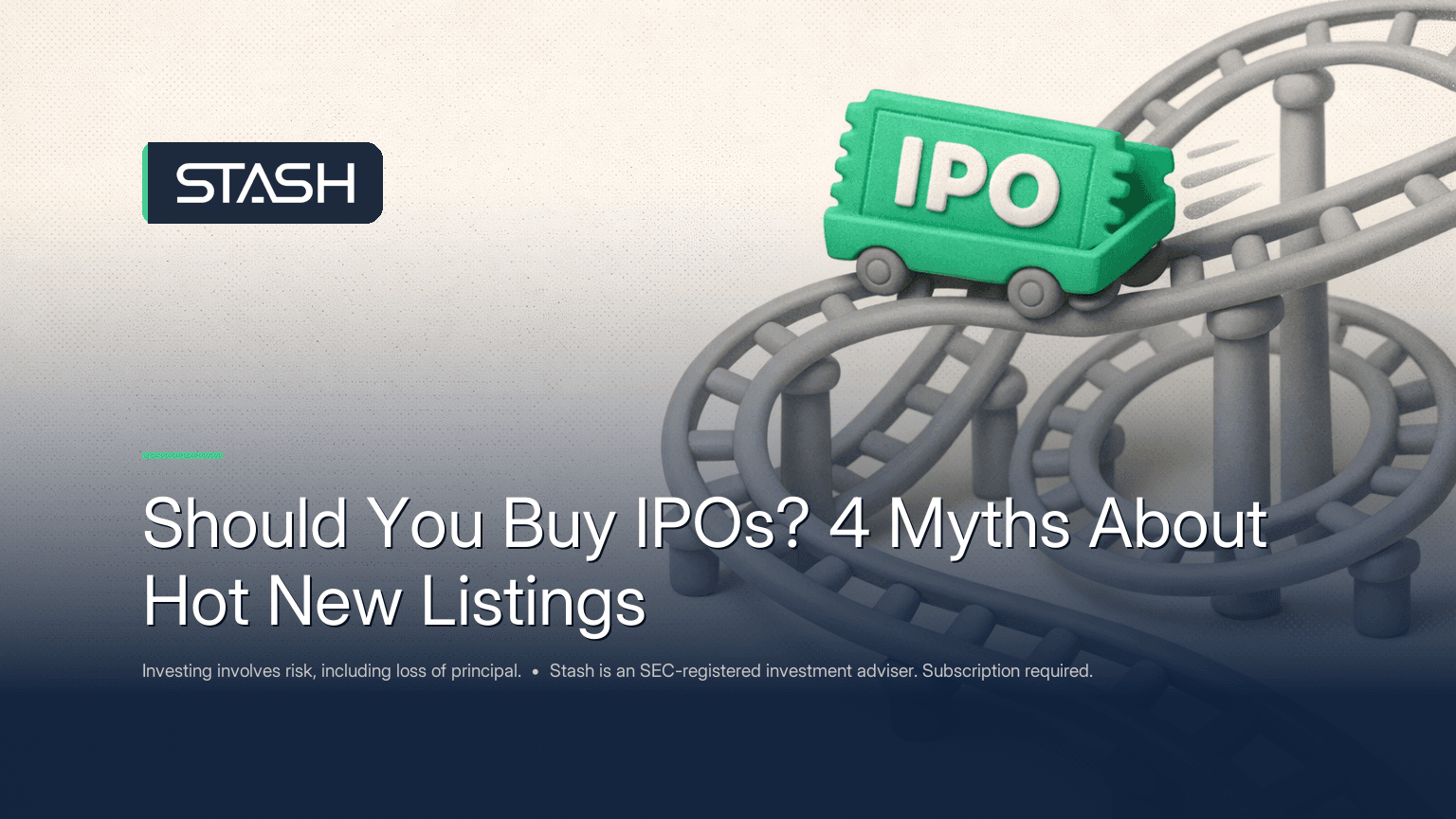
Should You Buy IPOs? 4 Myths About Hot New Listings
Published: Jun 25, 2026
In this article:
- “Getting in early on a hot IPO is how regular people get rich.”
- “Buying on the first day means I got the IPO price.”
- “A big first-day pop means it’s a great long-term investment.”
- “If everyone on the app is buying it, it must be smart.”
- Explore these on Stash
- Bottom line
- Important disclosures
- Frequently asked questions
By Ed Robinson, Co-Founder & Co-CEO, Stash · FINRA Series 7 & 63 · Graduate Diploma in Financial Planning · Last updated June 25, 2026
The headline difference: chasing a hot IPO on day one is not the same as getting in early at the IPO price. IPO myths stick around because the stories are simple: a famous company lists, the stock jumps, and social feeds make it feel like everyone else saw it coming. For more context, read How to read market news as an everyday investor. This is general guidance; what’s right for you depends on your specific situation.
What you hear | What IPOs often look like in real life |
|---|---|
“Early” means the IPO price | Many retail investors see the first public market price, not the allocation price |
A first-day jump proves quality | A pop can reflect limited supply, hype, or pricing choices |
Popularity lowers risk | Concentration risk still exists when many people crowd into one name |
“Getting in early on a hot IPO is how regular people get rich.”
What people believe: if a company is famous before it lists, buying near the start must be the path to a huge payoff. That story feels even stronger when the name is already part of your daily news feed, like SpaceX, Anthropic, or OpenAI. If you are tracking private-company buzz, see What an Anthropic IPO Could Mean for Everyday Investors.
What is actually true: early access and early trading are not the same thing. University of Florida finance professor Jay Ritter’s IPO research has long shown that IPOs as a group can trail comparable public companies over the years after listing, even when the first day looks exciting. Renaissance Capital also reported that the 2021 IPO class was down 57% on average by the end of 2022.
That does not mean every IPO follows the same path. It means the “regular people get rich by chasing the hot name” story leaves out risk, valuation, and timing. A company can be important and still have a stock price that moves in ways you did not expect.
“Buying on the first day means I got the IPO price.”
What people believe: if the headline says a company priced its IPO at $34, and you buy that morning, you got in at $34. That is usually not how the process works. If you want the mechanics, read What Is an IPO? How It Works for Everyday Investors.
What is actually true: the IPO price is set before public trading starts, and allocations often go to institutions and selected clients. The SEC explains that IPO shares may not be available to all investors at the offering price. Once trading opens, the market price can be much higher or lower than the IPO price.
A real example helps. Nasdaq market data showed Reddit priced its 2024 IPO at $34 per share and opened at $47. So a person who bought at the open did not get the IPO price. They got the first public trading price, after the initial jump had already happened.
“A big first-day pop means it’s a great long-term investment.”
What people believe: a big opening move means the market has confirmed the company’s long-term path. That is tempting, because a first-day pop is easy to see. Long-term business results are harder to judge, and they can take quarters or years to show up.
What is actually true: a pop can say more about supply and demand on one day than about future results. Ritter’s IPO data shows average first-day returns have often been positive across decades, but that same research also points to weaker average long-run performance for many IPO groups versus comparable public companies.
There is another factor: lock-up expirations. The SEC says IPO lock-up agreements commonly restrict insiders from selling for a set period, often 180 days. When those restrictions expire, more shares may become available. That extra supply can affect price, especially if early holders want liquidity.
This is where patience can matter. Some investors wait for earnings reports, analyst coverage, and lock-up dates before forming a view. That is not a command to wait. It is one way to avoid making a decision based only on day-one noise.
“If everyone on the app is buying it, it must be smart.”
What people believe: if a stock is everywhere, the crowd must know something. Over the trailing 14 days ending June 25, 2026, SpaceX was 41% of all completed manual buy orders on Stash, according to Stash internal data, trailing 14 days ending June 2026. For background, see What a SpaceX IPO Could Mean for Everyday Investors.
What is actually true: popularity is not diligence. “Manual” here means a member actively chose the order, rather than using an automatic recurring Auto-Stash. When about 4 in 10 deliberate buys pile into one fresh listing, that is a clear example of concentration risk, not a full investing plan.
FINRA warns that concentrated positions can expose investors to bigger losses if one company or sector falls. That risk exists even when the company is widely known. A diversified portfolio spreads risk across many holdings, which can reduce the impact of one stock’s sharp move.
Frequently asked questions
Should you buy IPOs as a beginner?
This is not a recommendation to buy, sell, or avoid any IPO. Beginners can think about how much of their portfolio would sit in one new stock, how much public financial history exists, and whether they understand lock-ups. IPOs can be volatile, especially in the first months.
Why do IPOs pop on the first day?
A first-day pop can happen when demand is higher than the number of shares available at the offering price. Underwriters may also price the deal to support demand. A pop does not prove the company’s long-term value. It shows where buyers and sellers met that day.
How do Fed rates affect IPO hype?
Higher rates can make investors more selective, because future profits may be worth less in today’s dollars. Lower rates can support more risk-taking. For a deeper primer, read How Fed rate decisions affect everyday investors.
Do IPOs behave differently in bear markets?
They can. In a What is a bear market?, investors may demand lower valuations and more proof of profits. Some companies delay listings. Others list anyway, but trading can be choppier because buyers are less willing to pay for uncertain future growth.
Is Auto-Stash related to IPO investing?
Auto-Stash automates the saving and investing decision. That can help separate a long-term contribution habit from one-off excitement around a new listing. It does not remove investment risk, and it does not decide whether any IPO fits your situation.
Explore these on Stash
These ETFs are available to invest in on Stash. This list is educational and is not a recommendation to buy any security.
First Trust NASDAQ Cybersecurity ETF (CIBR) - Tracks a Nasdaq index
Invesco QQQ Trust Series I (QQQ) - Tracks a Nasdaq index
Bottom line
The durable lesson is patience over day-one FOMO. Hot IPOs can be exciting news, but the IPO price, opening price, first-day pop, and long-term outcome are different things. Before reacting to the crowd, weigh concentration, diversification, lock-ups, and time. Stash is a regulated investment adviser — not a bank — and all investing involves risk, including possible loss of principal.
Important disclosures
Investing involves risk, including the possible loss of principal. See full disclosures at www.stash.com/disclosures.
Educational only and is not a recommendation to buy, sell, or hold any security. See full disclosures at www.stash.com/disclosures.
IPOs and SPACs can be highly volatile and involve significant risk. Availability through any particular brokerage is not guaranteed, and Stash does not offer access to IPO allocations.
Stash is not a bank. Banking services are provided by a partner bank, and FDIC insurance is provided through that partner bank.
Educational only and does not constitute investment, legal, accounting, or tax advice. See full disclosures at www.stash.com/disclosures.

Written by
Team Stash
We want to turn money into a source of hope and opportunity. We teach people how to build good habits, save more and make it easy and affordable to get started investing. So far, we’ve helped over 6 million people create a more secure financial future with our expert advice and award winning investing app.
Related articles
investing
Jun 25, 2026
Should You Buy IPOs? 4 Myths About Hot New Listings
investing
Jun 18, 2026
Best Index Funds for Beginners and How to Pick One
investing
Jun 10, 2026
What Is an Index Fund? A Complete Beginner's Guide
investing
Jun 09, 2026
How to Start Investing: A Beginner’s Guide for 2026
investing
Jun 04, 2026
What Is Quantum Computing? An Investor’s 2026 Guide
investing
Jun 03, 2026
What Is an IPO? How It Works for Everyday Investors

By using this website you agree to our Terms of Use and Privacy Policy. To begin investing on Stash, you must be approved from an account verification perspective and open a brokerage account.