How to Invest in Index Funds: A Beginner's Guide
Published: Mar 28, 2025
• Updated: Jun 25, 2026
In this article:
- What are index funds?
- Why do investors use index funds?
- How do you invest in index funds step by step?
- Which index funds can beginners compare?
- Is trading index funds different from investing in index funds?
- What could $100,000 invested in an S&P 500 index fund become?
- What risks should you understand before buying index funds?
- How are index funds taxed?
- How do index funds fit into the Stash way to invest?
- FAQ about index funds
By Stash Team
Last updated: June 25, 2026
Index funds are mutual funds or ETFs that aim to match a market index, such as the S&P 500, instead of trying to pick winning stocks. To invest in index funds, choose an account, compare costs, pick a diversified fund, decide how much to invest, and contribute consistently.
That is the simple version. The useful version is knowing which account to use, what fees matter, how much risk you are taking, and why trading index funds like hot stocks can work against you.
What are index funds?
Index funds are investment funds built to track a specific benchmark, such as the S&P 500, Nasdaq-100, Dow Jones Industrial Average, Russell 2000, or a total stock market index.
Think of an index like a recipe. The S&P 500 recipe includes about 500 large U.S. companies. An S&P 500 index fund tries to hold the same ingredients in similar proportions, so its performance closely follows the index before fees and tracking differences.
Index funds usually come in two formats:
Index mutual funds: Bought and sold once per trading day after the market closes.
Index ETFs: Bought and sold during the trading day like stocks.
Both can be solid tools for long-term investors. The bigger question is not whether the wrapper is a mutual fund or ETF. It is whether the fund is diversified, low cost, easy to understand, and appropriate for your time horizon and risk tolerance.
Why do investors use index funds?
Investors use index funds because they offer broad diversification, low costs, and a simple way to invest for the long term without trying to outguess the market.
Here is why that matters.
Diversification spreads out single-company risk
A broad index fund can hold hundreds or thousands of companies. If one company has a bad year, it may not sink the whole fund. You still have market risk, but you are not betting your future on one ticker.
Low fees leave more of your return invested
Index funds are typically passively managed, so they often cost less than actively managed funds. The fee to watch is the expense ratio, which is the annual fund cost shown as a percentage of your investment.
Example: If you invest $10,000:
A 0.03% expense ratio costs about $3 per year.
A 0.75% expense ratio costs about $75 per year.
That difference may sound small for one year. Over decades, fees can compound against you. Stash has a strong point of view here: investing should not be locked behind confusing costs or expensive advice. Low-cost, diversified investing is one way regular people can get more of the market working for them.
Simplicity can help you stay invested
Most people do not need a screen full of charts to build a portfolio. They need a plan they can stick with. Index funds can help because you know what you own: a slice of a market, sector, country, or bond index.
How do you invest in index funds step by step?
You invest in index funds by opening the right type of account, choosing a fund, placing an order, and setting a repeatable contribution plan.
1. Choose the account first
The account decides your tax treatment and access rules. The index fund is what you buy inside the account.
Common options include:
Taxable brokerage account: Flexible access, but dividends and realized gains may be taxable.
Traditional IRA: Potential tax deduction now, with taxes generally due on withdrawals.
Roth IRA: Contributions are made with after-tax dollars, and qualified withdrawals may be tax-free.
401(k), 403(b), or similar workplace plan: Often funded through payroll and may include an employer match.
For 2025 tax-year reference, the IRA contribution limit was $7,000, or $8,000 if age 50 or older. The 401(k) employee deferral limit was $23,500, with an additional $7,500 catch-up for many workers age 50 or older. Under SECURE 2.0, some workers ages 60 to 63 could use a higher catch-up limit of $11,250 if their plan allowed it. Limits can change, so check the current IRS limit before contributing.
2. Decide what you want the fund to do
Pick the job before you pick the fund.
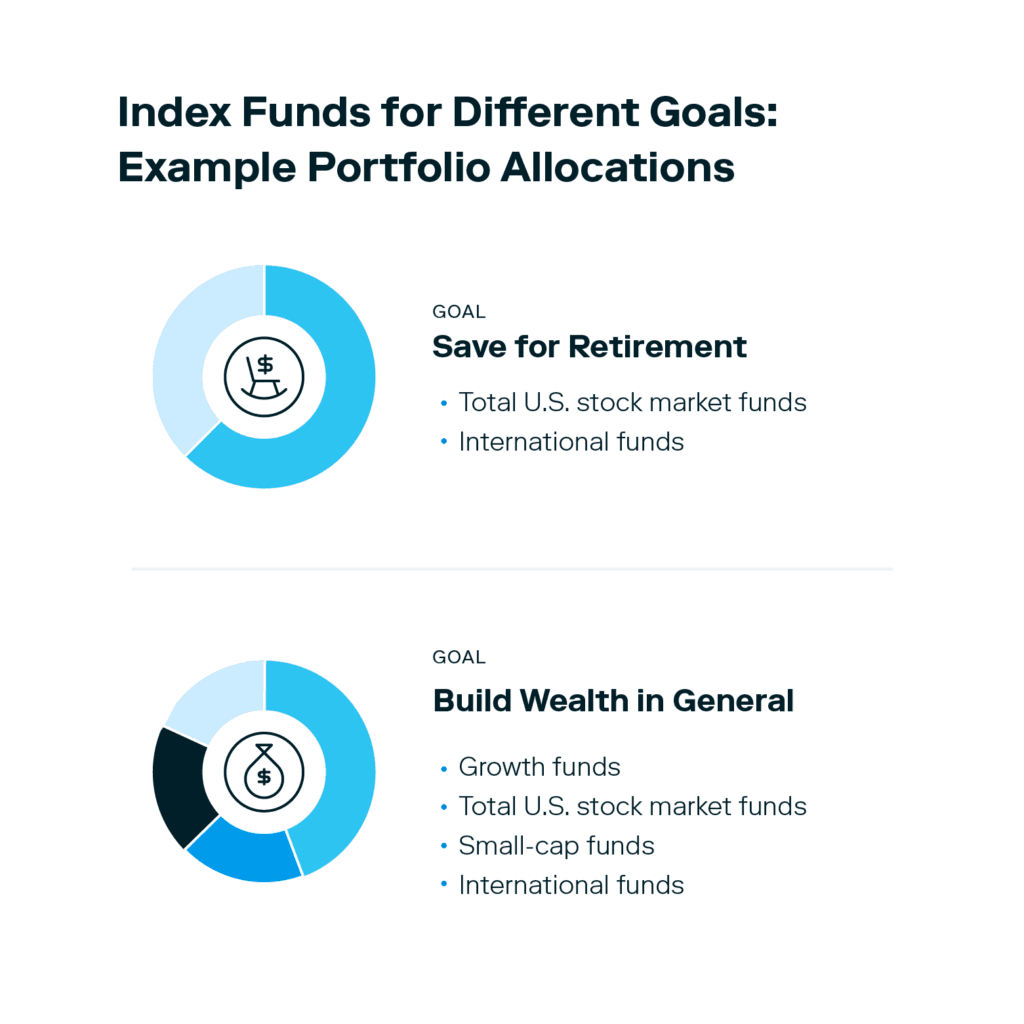
Need broad U.S. stock exposure? Look at total U.S. stock market or S&P 500 index funds.
Want global stock exposure? Look at total international or global index funds.
Want lower volatility than an all-stock portfolio? Bond index funds may play a role.
Want a single fund that adjusts over time? A target-date index fund may be worth comparing.
This is where guidance helps. Many people are told to invest, then left with a list of tickers and jargon. Stash is built around a different idea: a financial advisor in your pocket, with guidance for everyone, not just people with large balances.
3. Compare the key fund details
Compare index funds on the details that actually affect you.
Expense ratio: Lower is generally better, all else equal.
Index tracked: Make sure you know what market the fund follows.
Holdings: Check whether the fund owns a few dozen companies or thousands.
Minimum investment: Some mutual funds have minimums; many ETFs allow fractional shares on some platforms.
Tracking difference: This shows how closely the fund has matched its index after costs.
Trading costs and spreads: More relevant for ETFs, especially niche funds.
Do not choose a fund only because it was up recently. A hot performance chart can be a poor substitute for a durable plan.
4. Choose your investment amount
Your first index fund investment can be small, because consistency matters more than trying to time the perfect entry point.
If you have $5,000 to invest, one simple framework is to separate money by time horizon:
Money needed soon: usually not ideal for stock index funds because the market can drop when you need cash.
Money for retirement or goals 5 to 10+ years away: may fit better with diversified stock and bond index funds.
Money earmarked for debt, emergencies, or bills: may belong outside the market.
This is not a one-size-fits-all rule. It is a way to avoid putting short-term money into long-term investments.
5. Place the order
For an index mutual fund, you usually enter a dollar amount and the order executes after the market closes.
For an index ETF, you can often enter a dollar amount if your platform supports fractional shares, or you can enter a share quantity. Many long-term investors use market orders for highly liquid broad-market ETFs, but limit orders can help control the maximum price you pay, especially for less liquid ETFs.
6. Automate contributions if it fits your budget
Automatic contributions can help you invest consistently through good markets and bad markets.
This is called dollar-cost averaging: investing a fixed amount on a regular schedule. Sometimes you buy when prices are high. Sometimes you buy when prices are lower. The goal is not to predict every market move. The goal is to keep your plan moving.
7. Review periodically, not constantly
Review your index funds a few times a year or after major life changes, not every time the market has a rough week.
A useful review asks:
Does my portfolio still match my time horizon?
Am I too concentrated in one country, sector, or asset class?
Have fees changed?
Do I need to rebalance?
Am I taking more risk than I can stomach?
Investing involves risk, and you can lose money. The point of index investing is not to avoid every downturn. It is to build a portfolio you can live with through them.
Which index funds can beginners compare?
Beginners can compare broad-market index funds first because they are usually easier to understand than narrow sector or theme funds.
Common categories include:
S&P 500 index funds: Track about 500 large U.S. companies.
Total U.S. stock market index funds: Include large, mid-size, and small U.S. companies.
Total international stock index funds: Track companies outside the U.S.
Total bond market index funds: Track broad segments of the bond market.
Target-date index funds: Hold a mix of stocks and bonds that becomes more conservative as the target year approaches.
Sector index funds: Focus on one area, such as technology, healthcare, energy, or real estate.
Broad funds are often a cleaner starting point because they reduce the temptation to chase whatever sector is in the headlines. Sector funds can be useful for some investors, but they add concentration risk.
Is trading index funds different from investing in index funds?
Trading index funds means buying and selling frequently, while investing in index funds usually means holding diversified funds for years and contributing over time.
This distinction matters. Index ETFs make trading easy. Easy does not mean wise.
Day-trading culture sells activity as control. The data is much less glamorous. Academic research has found that fewer than 1% of day traders generate positive returns over time. Index funds were built to make broad ownership easier, not to turn investing into a casino app.
Stash’s view: most investors are better served by long-term diversification, consistent contributions, and guidance than by trying to win a daily guessing contest against professionals, algorithms, and their own emotions.
What could $100,000 invested in an S&P 500 index fund become?
A $100,000 investment in an S&P 500 index fund could rise or fall in any given year, but a long-term calculator can show how compounding works under different return assumptions.
This example is hypothetical. It is not a prediction. It also does not include taxes, inflation, fund fees, or future market downturns.
Average annual return | After 10 years | After 20 years | After 30 years |
|---|---|---|---|
5% | $162,889 | $265,330 | $432,194 |
7% | $196,715 | $386,968 | $761,226 |
9% | $236,736 | $560,441 | $1,326,768 |
The lesson is not that the S&P 500 will deliver one of these exact numbers. The lesson is that time and compounding do a lot of heavy lifting when you stay invested. The hard part is staying invested when the market is noisy.
What risks should you understand before buying index funds?
Index funds reduce single-stock risk, but they still carry market risk, concentration risk, tax risk, and behavior risk.
Market risk
If the market or index falls, the fund can fall too. An S&P 500 index fund can have sharp declines during recessions, rate shocks, and bear markets.
Concentration risk
Some indexes are more concentrated than they look. A market-cap-weighted index gives bigger companies more influence. If the largest companies struggle, the index can feel it.
Sector and theme risk
A clean energy, semiconductor, crypto-related, or healthcare index fund may sound diversified, but it can still be a concentrated bet on one area of the market.
Currency and country risk
International index funds can be affected by foreign markets, currencies, regulations, and political events.
Inflation risk
If your returns do not keep up with inflation after taxes and fees, your purchasing power may decline.
Behavior risk
Selling after drops and buying after rallies can hurt long-term results. The fund may be passive, but the investor still has to make active choices about contributions, withdrawals, and rebalancing.
How are index funds taxed?
Index funds can create taxes through dividends, capital gains distributions, and gains when you sell shares for more than you paid.
In a taxable brokerage account:
Dividends may be taxed in the year you receive them, even if you reinvest them.
Capital gains distributions may occur when a mutual fund passes gains to shareholders.
Selling shares at a profit can create a capital gain.
Selling shares at a loss may create a capital loss that could offset other taxable gains, subject to IRS rules.
ETFs are often tax-efficient, but not tax-proof. Mutual funds can also be tax-efficient, especially broad index funds. In IRAs and workplace retirement plans, taxes generally depend on the account type and withdrawal rules rather than each fund trade.
Taxes can get personal fast, so consider a qualified tax professional for your situation.
How do index funds fit into the Stash way to invest?
Index funds fit the Stash way because they can help investors build diversified portfolios, keep costs visible, invest consistently, and focus on long-term goals instead of market hype.
Our view is simple: investing should not require a finance degree, a giant account balance, or a private advisor. It should be understandable. It should be accessible. And it should come with guidance that helps you make the next reasonable move.
Index funds are not magic. They will not protect you from every loss. But used thoughtfully, they can be one of the clearest tools for building a long-term portfolio.
FAQ about index funds
What are index funds in simple terms?
Index funds are baskets of investments designed to copy the performance of a market index, such as the S&P 500 or a total stock market index.
How do I start investing in index funds?
Start by choosing an investment account, deciding your goal and time horizon, comparing low-cost diversified index funds, placing your first order, and setting a contribution schedule that fits your budget.
Are index funds mutual funds or ETFs?
Index funds can be either mutual funds or ETFs. The index describes the strategy, while the mutual fund or ETF structure describes how the investment is bought, sold, and operated.
Can you trade index funds?
You can trade index ETFs throughout the market day, while index mutual funds trade once per day after the market closes. Frequent trading adds risk and can work against a long-term plan.
Are S&P 500 index funds good for beginners?
S&P 500 index funds can be a simple starting point for U.S. large-company exposure, but they are not a complete portfolio for everyone because they do not include every asset class or all global markets.
How much money do I need to invest in index funds?
Some platforms allow fractional ETF shares or low-minimum mutual funds, so you may be able to start with a small dollar amount. The right amount depends on your budget, emergency savings, debt, and goals.
What is the average return of the S&P 500?
The S&P 500 has historically averaged about 10% annually before inflation over long periods, but annual returns vary widely and future returns can be higher or lower.
What happens if I invest $100,000 in an S&P 500 index fund?
The value can rise or fall with the market. Over long periods, compounding can be powerful, but taxes, fees, inflation, timing, and market downturns all affect the actual result.
Are index funds safer than individual stocks?
Broad index funds are usually more diversified than individual stocks, which can reduce single-company risk. They still carry market risk and can lose value.
Do index funds pay dividends?
Many stock index funds pay dividends from the companies they hold. Those dividends may be taxable in a brokerage account unless sheltered by a tax-advantaged account.
What is the difference between index funds and actively managed funds?
Index funds try to match an index, while actively managed funds try to outperform a benchmark through manager decisions. Active funds often have higher fees and may or may not beat their benchmark.
Should I invest all my money in one index fund?
One fund can be diversified, but it may not cover every market or risk level you need. Many investors use a mix of stock and bond index funds based on time horizon and risk tolerance.

Written by
Team Stash
We want to turn money into a source of hope and opportunity. We teach people how to build good habits, save more and make it easy and affordable to get started investing. So far, we’ve helped over 6 million people create a more secure financial future with our expert advice and award winning investing app.
Related articles
investing
Oct 02, 2026
Trust your money to experts, not chatbots
investing
Jun 25, 2026
Should You Buy IPOs? 4 Myths About Hot New Listings
investing
Jun 18, 2026
Best Index Funds for Beginners and How to Pick One
investing
Jun 10, 2026
What Is an Index Fund? A Complete Beginner's Guide
investing
Jun 09, 2026
How to Start Investing: A Beginner’s Guide for 2026
investing
Jun 04, 2026
What Is Quantum Computing? An Investor’s 2026 Guide

By using this website you agree to our Terms of Use and Privacy Policy. To begin investing on Stash, you must be approved from an account verification perspective and open a brokerage account.