How does compound interest work?
Published: Apr 21, 2025
• Updated: Apr 27, 2025

In this article:
- What Is Compound Interest, and Why Is It Important?
- Understanding the Formula for Compound Interest
- Real-Life Examples of Compound Interest at Work
- The Power of Time in Compound Interest
- Common Misconceptions About Compound Interest
- Practical Tips to Maximize Compound Interest
- Take Control of Your Financial Future
Interested in growing your money faster over time? Compound interest is a powerful financial concept that can help you build wealth with minimal effort. Whether you're just starting to explore personal finance or looking for smarter ways to invest, understanding compound interest is a critical step toward making informed financial decisions.
By the end of this blog, you'll not only know the ins and outs of how compound interest works but also understand how to leverage it to your advantage. Let's get started!
What Is Compound Interest, and Why Is It Important?
Compound interest is the interest you earn on both the initial amount of money you invest or save (called the principal) and the interest that accumulates over time. Essentially, your money earns interest, and then that interest earns more interest. It’s often called “interest on interest,” and it’s the secret sauce behind the growth of long-term savings and investments.
Why Does Compound Interest Matter?
The magic of compound interest lies in how it accelerates the growth of your wealth over time. The longer your money is left to grow, the more dramatic the results. This is why it’s often considered one of the most powerful tools in personal finance.
For young adults and beginner investors, starting early can make a huge difference. With compound interest, time is your greatest ally. The sooner you begin, the more opportunities you give your money to grow exponentially.
Understanding the Formula for Compound Interest
Don't worry—we’ll break the formula down so it’s simple to understand.
The standard formula for compound interest is:
A = P(1 + r/n)^(nt)
Here’s what each term means:
A = The future value of your investment or savings (including interest).
P = The principal, or the initial deposit or investment.
r = The annual interest rate (in decimal form, e.g., 5% = 0.05).
n = The number of times interest is compounded per year.
t = The number of years the money is invested or saved.
Breaking It Down
Principal (P): This is your starting amount. Whether it’s $1,000 in a savings account or $5,000 in an investment fund, this is the foundation of your compound growth.
Rate (r): The annual interest rate is the percentage your principal earns each year.
Time (t): The longer your money sits and compounds, the more significant the growth.
Example:
If you invest $1,000 at an interest rate of 5%, compounded annually for 10 years, your formula would look like this:
A = $1,000(1 + 0.05/1)^(1*10)
After simplifying:
A = $1,000(1.05)^10 = $1,628.89
This means your $1,000 would grow to $1,628.89 in 10 years, thanks to compound interest.
Real-Life Examples of Compound Interest at Work
To see how compound interest plays out in the real world, here are two scenarios where it works its magic:
1. Savings Accounts
Imagine you deposit $5,000 into a high-yield savings account with a 3% annual interest rate, compounded monthly. After 10 years, your nest egg grows significantly compared to earning simple interest.
2. Investments
Now consider investing $10,000 in a mutual fund with an 8% return, compounded annually. Over 20 years, compounding transforms your initial investment into an impressive $46,610. This is the power of compounding brought to life!
The Power of Time in Compound Interest
Did you know that starting earlier can produce a much larger outcome than saving a bigger amount later? This concept is often called the "time value of money."
Example of Time’s Impact
Person A saves $100/month starting at age 25, at an 8% return, for 10 years (stops at 35).
Person B starts saving $100/month at age 35 and continues until age 65, at the same return.
Guess what? Person A ends up with more money at retirement, even though they saved for a shorter period. This is because their money had more time to grow exponentially, thanks to compound interest.
Common Misconceptions About Compound Interest
Myth 1: You Have to Be Wealthy to Benefit from Compound Interest
Not true! Even small amounts can grow significantly over time with the power of compounding.
Myth 2: Compound Interest Isn’t Worth It for Young People
The exact opposite is true. Starting young means you give your money the maximum time to grow.
Myth 3: You Always Need a High Rate to Reap Rewards
While a higher rate helps, the frequency of compounding (how often your interest compounds) and the length of time matter just as much.
Practical Tips to Maximize Compound Interest
You now understand how compound interest works. But how can you use it to build wealth? Here are some actionable tips.
Start ASAP: The earlier you start saving or investing, the more time your money has to grow. Every year counts!
Choose the Right Accounts: Look for high-yield savings accounts, retirement accounts like 401(k)s or IRAs, and investment platforms with good compounding options.
Invest Regularly: Consistency is key. Contribute regularly to your savings or investments, even if it’s just a small amount.
Auto-Reinvest Earnings: Always reinvest your dividends, interest, or earnings to maximize compounding.
Avoid Withdrawals: Keep your money untouched to allow compounding to work uninterrupted.
Take Control of Your Financial Future
Compound interest is more than just a financial concept; it’s a long-term strategy for financial growth. By understanding its power and putting it into action, you can set yourself up for a brighter financial future.
Remember, it’s not just about saving but about starting early, staying consistent, and letting time do most of the work.
Looking to make smarter financial decisions starting today? Don’t wait longer to take action. Explore tools that help you save and invest wisely, and watch the magic of compound interest grow your wealth.

Written by
Team Stash
We want to turn money into a source of hope and opportunity. We teach people how to build good habits, save more and make it easy and affordable to get started investing. So far, we’ve helped over 6 million people create a more secure financial future with our expert advice and award winning investing app.
Related articles
investing
Oct 02, 2026
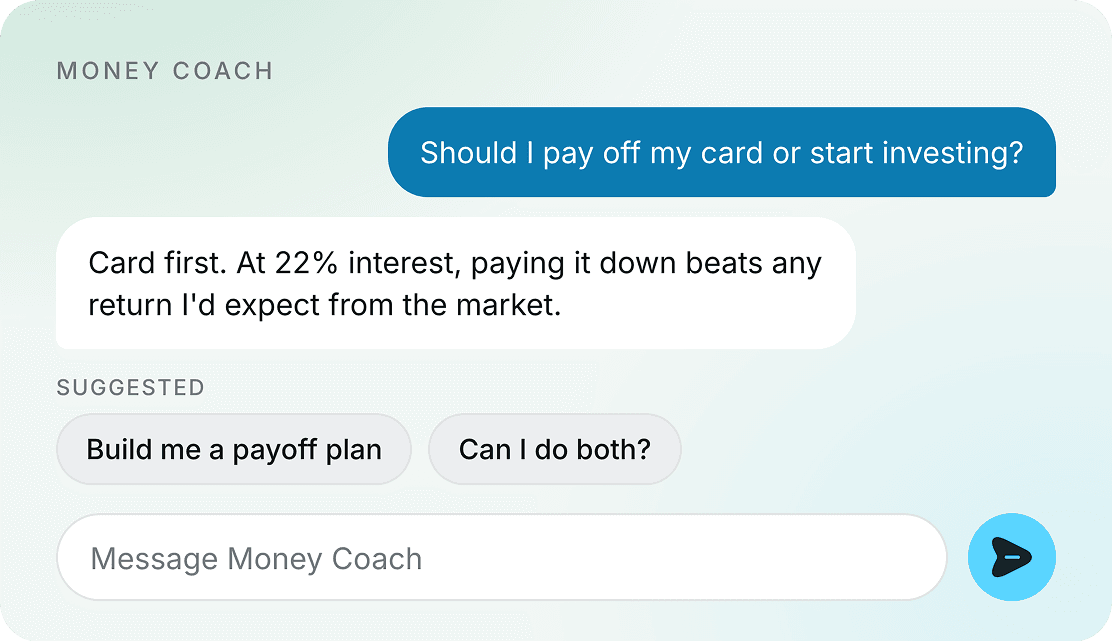
Trust your money to experts, not chatbots

investing
Jun 25, 2026
Should You Buy IPOs? 4 Myths About Hot New Listings
investing
Jun 18, 2026
Best Index Funds for Beginners and How to Pick One
investing
Jun 10, 2026
What Is an Index Fund? A Complete Beginner's Guide
investing
Jun 09, 2026
How to Start Investing: A Beginner’s Guide for 2026

investing
Jun 04, 2026
What Is Quantum Computing? An Investor’s 2026 Guide

By using this website you agree to our Terms of Use and Privacy Policy. To begin investing on Stash, you must be approved from an account verification perspective and open a brokerage account.