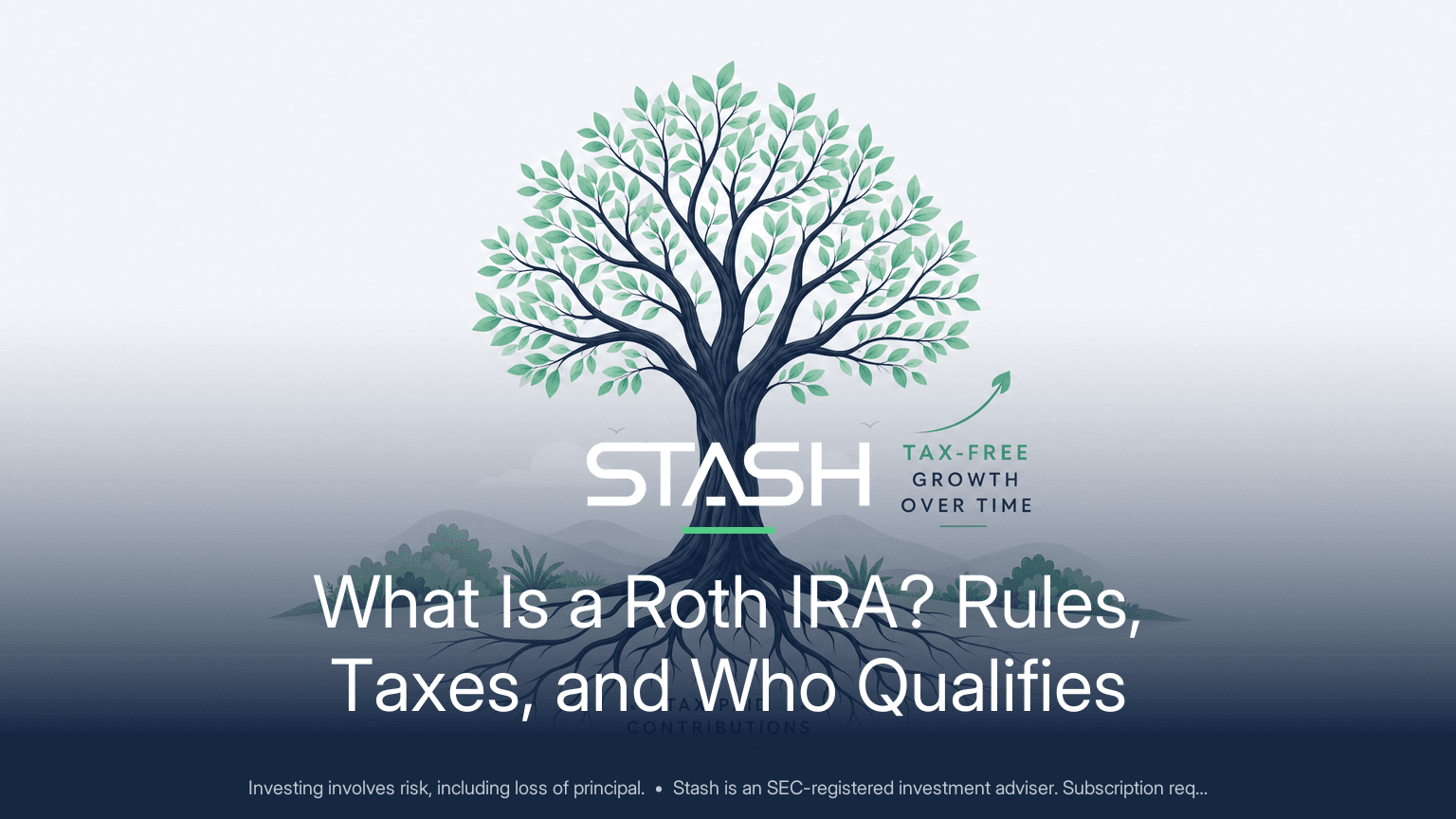
What Is a Roth IRA? Rules, Taxes, and Who Qualifies
Published: Jun 06, 2026
In this article:
- What is a Roth IRA?
- Roth IRA rules for 2026
- Roth IRA requirements: who qualifies?
- Requirements to open a Roth IRA account
- How a Roth IRA works
- Roth IRA contribution rules
- Roth IRA withdrawal rules
- The Roth IRA 5-year rule, explained
- Roth IRA vs. traditional IRA
- Roth IRA vs. 401(k)
- Roth IRA minimums: how much do you need to start?
- Why a Roth IRA matters for everyday investors
- Common Roth IRA mistakes to avoid
- Bottom line
- Important disclosures
- Frequently asked questions
By Ed Robinson, Co-Founder & Co-CEO, Stash · FINRA Series 7 & 63 · Graduate Diploma in Financial Planning · Last updated July 06, 2026
A Roth IRA is a retirement account you fund with money you’ve already paid taxes on. The trade-off is simple: no federal tax deduction today, but qualified withdrawals of earnings in retirement are generally not taxed at the federal level.
That can be powerful. It can also be misunderstood. A Roth IRA is not a magic account, a loophole, or a hot-stock playground. It’s a long-term investing account with IRS rules: contribution limits, income requirements, withdrawal rules, and real investment risk.
Used well, a Roth IRA gives your future self more choices.
What is a Roth IRA?
A Roth IRA is an individual retirement arrangement, commonly called an individual retirement account, that you open outside your employer. You contribute after-tax dollars, then choose investments inside the account. Depending on your provider, those investments may include ETFs, stocks, bonds, mutual funds, managed portfolios, or cash-like options.
Think of a Roth IRA like a lunchbox with special tax rules. The lunchbox is the account. The food inside is what you invest in. Opening the lunchbox is not the same as packing it.
Here’s the core trade-off:
You do not get a federal tax deduction for Roth IRA contributions.
Your money can be invested for the long term.
Qualified withdrawals of earnings are generally not taxed at the federal level if you meet IRS rules.
You can generally withdraw your direct contributions at any time without federal income tax or the 10% early withdrawal penalty.
Unlike a workplace 401(k), a Roth IRA is not tied to your job. If you change employers, switch careers, or take time away from paid work, the Roth IRA can stay with you.
This article is general education, not personalized tax or investment advice. Stash is a regulated investment adviser, not a bank, and we do not push specific securities.
Roth IRA rules for 2026
For tax year 2026, the IRA contribution limit is $7,500 if you’re under age 50. If you’re age 50 or older, you can contribute an additional $1,100 catch-up contribution, for a total of $8,600.
That limit applies to your traditional IRA and Roth IRA contributions combined. It is not a separate limit for each account.
For 2026, direct Roth IRA contribution eligibility phases out at these modified adjusted gross income, or MAGI, ranges:
Tax filing status | 2026 Roth IRA direct contribution phaseout range |
|---|---|
Single or head of household | $153,000 to $168,000 |
Married filing jointly | $242,000 to $252,000 |
Married filing separately, if you lived with your spouse at any time during the year | $0 to $10,000 |
If your income is below the phaseout range, you may be able to make the full contribution. If your income falls inside the range, your allowed contribution is reduced. If your income is above the range, you cannot contribute directly to a Roth IRA for that year.
A few rules matter:
You need earned income, such as wages, salary, tips, commissions, or self-employment income.
You cannot contribute more than your earned income for the year.
The IRA limit is shared across Roth and traditional IRAs.
401(k) contributions do not count against your IRA limit.
The 2026 contribution deadline is generally April 15, 2027, not including extensions, unless the IRS changes the deadline for a specific reason such as a disaster declaration.
Example: if you’re under 50 and put $4,000 into a traditional IRA for 2026, you can contribute up to $3,500 to a Roth IRA for 2026 if you’re otherwise eligible.
Roth IRA requirements: who qualifies?
To qualify for a Roth IRA contribution, you generally need to pass three tests.
1. You need earned income
Earned income usually includes wages, salary, tips, commissions, taxable alimony, and net self-employment income. Investment income, pension income, Social Security benefits, and rental income usually do not count as earned income for IRA contribution purposes.
If you earn $4,000 from a job in 2026, your IRA contribution limit is not automatically $7,500. It is capped at your earned income, so your maximum IRA contribution would generally be $4,000.
2. Your income must fit the Roth IRA limits
Roth IRA income eligibility is based on MAGI, not necessarily the salary number you quote in conversation. MAGI can include adjustments that make the math less obvious.
If your income is near the phaseout range, check the IRS worksheet or talk with a tax professional before contributing. Guessing can get expensive because excess contributions may trigger penalties.
3. Your total IRA contributions must stay under the annual limit
For 2026, your combined Roth IRA and traditional IRA contributions cannot exceed $7,500 if you’re under 50, or $8,600 if you’re 50 or older. Having multiple IRAs does not multiply your limit.
Requirements to open a Roth IRA account
Qualifying to contribute to a Roth IRA is an IRS issue. Opening a Roth IRA account is also a provider issue.
Most brokerages or investing apps will ask for information such as:
Your legal name
Date of birth
Social Security number or taxpayer identification number
U.S. residential address
Employment information
Basic financial details
A funding source, such as a linked external bank account
You do not need to be rich. The IRS does not set a minimum dollar amount to open a Roth IRA. Providers may set their own account minimums, investment minimums, or subscription fees, so read the fine print before you open an account.
That’s a Stash hill we’ll stand on: retirement investing should not be reserved for people who already have a giant balance or a private advisor. You deserve a clear why for every recommendation, plain-English guidance, and tools that help you take the next step.
How a Roth IRA works
A Roth IRA has two parts: the account and the investments inside it.
Opening the account is step one. If the money sits in uninvested cash, it may not have much chance to outpace inflation. If you invest it, the balance can rise or fall based on the investments you choose, market conditions, time, and fees.
Here’s a worked example.
Maya is 30 and earns $92,000 a year. She contributes to a workplace 401(k) and wants another retirement bucket. She opens a Roth IRA and contributes $300 a month.
That’s $3,600 a year. Over 10 years, she contributes $36,000. She does not deduct those contributions on her federal tax return. But if she keeps the account long enough and follows the qualified distribution rules, her investment earnings may later be withdrawn without federal income tax.
There is no promised result. A diversified portfolio can still lose value, especially over short periods. But long-term investing gives compounding more time to work. That is the point of a Roth IRA: not guessing what will pop next week, but building a portfolio your future self can use.
Roth IRA contribution rules
Roth IRA contribution rules answer three questions: do you have earned income, how much did you make, and how much have you already contributed to IRAs this year?
You need earned income
Earned income usually includes wages, salary, tips, taxable alimony, commissions, and net self-employment income. Investment income, pension income, Social Security benefits, and rental income usually do not count as earned income for IRA contribution purposes.
Your income may limit direct contributions
Roth IRA income eligibility is based on MAGI. If your income is below the 2026 phaseout range for your filing status, you may be able to make the full contribution. If your income is inside the phaseout range, your allowed contribution is reduced. If your income is above it, direct Roth IRA contributions are not allowed for that tax year.
Some high-income investors explore a backdoor Roth IRA strategy. That usually involves contributing to a traditional IRA and converting it to a Roth IRA. It can create tax consequences, especially if you already have pre-tax IRA money, so get tax help before trying it.
Spouses may be able to contribute too
If you’re married filing jointly and one spouse has little or no earned income, a spousal IRA may allow contributions for that spouse as long as the couple has enough taxable compensation and meets the other rules.
A spousal Roth IRA is not a joint account. It belongs to the spouse whose name is on it.
Kids and teens can use Roth IRAs if they have earned income
There is no minimum age for a Roth IRA. A minor with earned income may be able to contribute, often through a custodial Roth IRA.
The contribution still cannot exceed the child’s earned income for the year or the annual IRA limit, whichever is lower. A teen who earns $2,500 from a summer job generally cannot contribute $7,500 to a Roth IRA for that year.
Roth IRA withdrawal rules
Roth IRAs are more flexible than many retirement accounts, but flexibility is not the same as permission to treat retirement money like a spare wallet.
The IRS generally treats Roth IRA withdrawals in this order:
Your direct contributions
Conversions and rollovers
Earnings
That order matters because direct contributions are usually the easiest money to access. Since you already paid taxes on contributions, you can generally withdraw them at any time without federal income tax or the 10% early withdrawal penalty.
Earnings are different. To withdraw earnings as a qualified distribution, you generally must meet both tests:
Your first Roth IRA contribution was made at least five tax years ago.
You are age 59½ or meet another qualifying condition, such as disability, death, or a first-time home purchase exception.
The first-time home purchase exception has a lifetime limit of $10,000 for earnings. It also has specific IRS requirements.
If you withdraw earnings too early, they may be subject to income tax and a 10% additional tax unless an exception applies. Conversions can also have their own five-year penalty clocks. This is one of those places where tax rules get sharp fast, so professional tax help can be worth it.
The Roth IRA 5-year rule, explained
The Roth IRA 5-year rule is easy to hear and easy to misunderstand.
For qualified withdrawals of earnings, the clock generally starts on January 1 of the tax year for your first Roth IRA contribution. If you make your first Roth IRA contribution for tax year 2026 before the April 2027 deadline, your five-year clock is treated as starting January 1, 2026.
Example: Jordan opens and funds a Roth IRA for the first time in March 2027, designating the contribution for tax year 2026. Jordan’s 5-year clock starts January 1, 2026. That does not mean all withdrawals are automatically exempt from federal income tax after five years. Jordan also generally needs to be 59½ or meet another qualifying condition for earnings to come out as a qualified distribution.
A simple way to remember it: contributions are your already-taxed money. Earnings get the special Roth tax treatment only after the IRS rules are satisfied.
Roth IRA vs. traditional IRA
Roth and traditional IRAs are both retirement accounts, but they flip the tax timing.
Feature | Roth IRA | Traditional IRA |
|---|---|---|
Contributions | After-tax | Pre-tax or after-tax, depending on deductibility |
Tax deduction now | No federal deduction | Possible, depending on income and workplace plan coverage |
Qualified withdrawals | Generally not taxed federally | Generally taxed as ordinary income |
Income limits | Income limits for direct Roth contributions | Income limits may affect deduction, not ability to contribute |
Required minimum distributions for original owner | No lifetime RMDs | RMDs generally required starting at age 73 |
Early access | Contributions generally accessible without federal tax or penalty | Early withdrawals generally taxable and may face penalty |
A Roth IRA may appeal to someone who expects their tax rate to be higher later or wants a retirement bucket with different tax treatment. A traditional IRA may appeal to someone who values a deduction now. Nobody can know future tax law with certainty, so tax diversification can be useful.
Roth IRA vs. 401(k)
A Roth IRA and 401(k) can both help with retirement, but they are built differently.
A 401(k) is an employer plan. It may offer an employer match, higher contribution limits, automatic payroll deductions, and a limited menu of investments. If your employer offers a match, that can be a valuable benefit to consider.
A Roth IRA is an individual account. It usually gives you more control over where you open it and what investments are available, but the contribution limit is much lower and income limits apply to direct Roth IRA contributions.
Many people use both. A common approach is to think in layers: workplace match, high-interest debt, emergency savings, then additional retirement contributions based on budget and goals. The exact order depends on your situation.
Roth IRA minimums: how much do you need to start?
The IRS does not require a minimum Roth IRA contribution. You can contribute less than the annual limit.
Providers may have their own rules. Some require a minimum to open an account, a minimum to buy certain investments, or a monthly fee. Others allow smaller starting amounts.
The more important question is not “Do I have enough to max it out?” It’s “Can I invest consistently in a way my budget can support?” Maxing out a Roth IRA is great if you can do it. Starting smaller can still be a real start.
For 2026, here’s what different contribution amounts look like:
Monthly contribution | Annual contribution |
|---|---|
$25 | $300 |
$100 | $1,200 |
$300 | $3,600 |
$625 | $7,500 |
About $717 | About $8,600 |
The $625 monthly figure gets an under-50 investor to the 2026 IRA limit of $7,500. The roughly $717 monthly figure gets an age-50-or-older investor to the 2026 limit of $8,600.
Why a Roth IRA matters for everyday investors
The investing industry loves making retirement sound harder than it is. That keeps too many people stuck, waiting until they feel like experts.
You do not need to be an expert to understand the rules. You need a clear path.
A Roth IRA can help in three practical ways.
First, it adds tax diversity. If most of your retirement savings are in a traditional 401(k), future withdrawals may be taxable. A Roth IRA can create another bucket with different tax treatment.
Second, it can reward time. The earlier money is invested, the more time it has to ride through market cycles. That does not remove risk, but it gives long-term investing room to work.
Third, it gives you ownership. A Roth IRA follows you across jobs. Your retirement plan should not depend entirely on one employer’s benefits menu.
Stash’s view is simple: long-term investing should not be reserved for people who already speak the language of finance. You deserve a financial advisor in your pocket, guidance when you need it, no appointment required, and a step-by-step plan for what to do next.
Common Roth IRA mistakes to avoid
Mistake 1: Opening a Roth IRA and not investing the money
A Roth IRA is the account. It does not automatically mean your cash is invested. If you want market exposure, you have to choose investments or use a managed portfolio option if your provider offers one.
Mistake 2: Contributing when your income is too high
If you contribute more than you’re allowed, you may face a 6% excise tax each year the excess remains in the account. If your income is near or above the Roth IRA phaseout range, check the rules before contributing.
Mistake 3: Forgetting the combined IRA limit
The annual IRA limit is not per account. It is shared across your Roth and traditional IRAs. Multiple accounts do not create extra contribution room.
Mistake 4: Treating a Roth IRA like everyday spending money
Yes, direct contributions are generally accessible. But a Roth IRA is designed for retirement. Pulling money out repeatedly can interrupt compounding and make it harder to build your portfolio over time.
Mistake 5: Chasing hype inside a tax-advantaged account
A Roth IRA’s tax benefits do not protect you from bad investing behavior. Concentrated bets, day-trading, and trend chasing can still hurt. The Stash approach is to invest for the long term, diversify, and invest consistently when your budget allows.
Frequently asked questions
What is a Roth IRA in simple terms?
A Roth IRA is a retirement account funded with money that has already been taxed. You do not get a federal tax deduction for contributions, but qualified withdrawals in retirement are generally not taxed at the federal level.
What are the Roth IRA requirements?
To contribute to a Roth IRA, you generally need earned income, must stay within the IRS income limits for direct Roth contributions, and cannot exceed the annual IRA contribution limit. For 2026, that limit is $7,500 if you’re under 50, or $8,600 if you’re 50 or older.
What are the requirements to open a Roth IRA?
To open a Roth IRA account, a provider will usually ask for identifying information such as your name, date of birth, Social Security number or taxpayer identification number, address, employment information, and a funding source. To contribute, you also need to meet IRS earned income and income-limit rules.
Who qualifies for a Roth IRA?
You generally qualify to contribute directly to a Roth IRA if you have earned income and your MAGI is below the IRS limit for your filing status. For 2026, the direct contribution phaseout range is $153,000 to $168,000 for single filers and heads of household, and $242,000 to $252,000 for married couples filing jointly.
What is the Roth IRA minimum?
The IRS does not set a minimum contribution for a Roth IRA. Providers may set their own minimums to open an account or invest in certain assets. You also cannot contribute more than your earned income for the year or the annual IRA limit, whichever is lower.
What are the Roth IRA contribution limits for 2026?
For 2026, the IRA contribution limit is $7,500 if you’re under age 50. If you’re age 50 or older, the catch-up contribution is $1,100, bringing the total to $8,600. This is the combined limit for Roth and traditional IRA contributions.
Can I have a Roth IRA and a 401(k)?
Yes. A 401(k) does not stop you from opening or funding a Roth IRA. The accounts have separate contribution limits. You still need earned income and must meet Roth IRA income eligibility rules.
Is a Roth IRA better than a 401(k)?
Not automatically. A 401(k) may offer an employer match and higher contribution limits. A Roth IRA may offer more individual control and different tax treatment. The better fit depends on your match, taxes, fees, income, investment choices, and timeline.
Can I lose money in a Roth IRA?
Yes. A Roth IRA is a tax-advantaged account, not a guaranteed investment. If the investments inside the account lose value, your balance can fall. Diversification can help manage risk, but it cannot eliminate risk.
Can I withdraw money from a Roth IRA before retirement?
You can generally withdraw your direct contributions at any time without federal income tax or the 10% early withdrawal penalty. Earnings have stricter rules. Early withdrawals of earnings may be taxable and penalized unless you meet IRS requirements or an exception applies.
What is the Roth IRA 5-year rule?
The 5-year rule generally requires five tax years to pass from your first Roth IRA contribution before earnings can be part of a qualified distribution. You usually also need to be 59½ or meet another qualifying condition.
Do Roth IRAs have required minimum distributions?
Roth IRAs do not have lifetime required minimum distributions for the original owner. Beneficiaries may have distribution rules after the owner dies.
Can I open a Roth IRA through an app?
Yes. Many investing apps offer Roth IRAs. Look for clear fees, investment options, education, account support, and whether the company is a regulated investment adviser or broker. Stash offers investing tools and guidance through subscription plans. Stash does not provide personalized tax advice.
Bottom line
A Roth IRA can be a strong retirement tool because it combines after-tax contributions, potential federally tax-advantaged qualified withdrawals, and long-term investing. The fine print matters: contribution limits, income eligibility, the 5-year rule, fees, and investment risk all shape how useful the account may be for you.
You do not have to decode retirement accounts from scratch. Start with the rules. Build your portfolio with a long-term mindset. Get guidance when you need it.
Important disclosures
Investing involves risk, including the possible loss of principal. Past performance is not a guarantee of future results.
Stash does not provide tax or legal guidance. Consult a qualified tax or legal professional about your own circumstances.
This material is for informational and educational purposes only and does not constitute investment, legal, accounting, or tax advice. The information reflects market conditions as of publication and may change without notice. Stash makes no guarantees regarding accuracy or future performance. Investing involves risk, including possible loss of principal. Examples are for illustrative purposes only and not recommendations to buy or sell any security or strategy. Past performance does not guarantee future results. For full disclosures, visit www.stash.com/disclosures.

Written by
Team Stash
We want to turn money into a source of hope and opportunity. We teach people how to build good habits, save more and make it easy and affordable to get started investing. So far, we’ve helped over 6 million people create a more secure financial future with our expert advice and award winning investing app.
Related articles
taxes-and-retirement
Jun 10, 2026
What Is a Backdoor Roth IRA and How It Works in 2026
taxes-and-retirement
Jun 10, 2026
Roth Conversion Explained: Taxes, Rules, and Timing
taxes-and-retirement
Jun 06, 2026
Roth IRA vs Traditional IRA: Which Fits Your Taxes
taxes-and-retirement
Jun 06, 2026
Roth IRA Contribution Limits 2026: Key Rules to Know
taxes-and-retirement
Jun 06, 2026
What Is a Roth IRA? Rules, Taxes, and Who Qualifies

taxes-and-retirement
Dec 15, 2025
FAQ: Retirement Portfolio

By using this website you agree to our Terms of Use and Privacy Policy. To begin investing on Stash, you must be approved from an account verification perspective and open a brokerage account.