Your Money Headlines this Week
Published: Jul 27, 2026
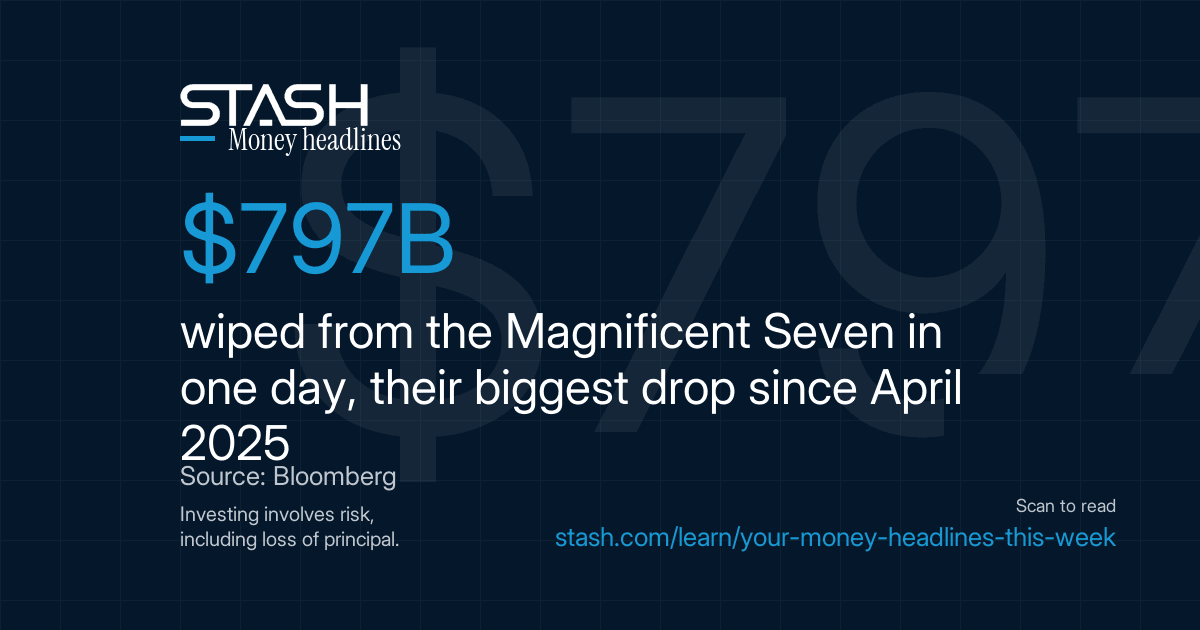
$797 billion came off the Magnificent Seven in a single day, according to Bloomberg. This week four of those companies (Microsoft, Meta, Apple, and Amazon) report earnings, and the Fed decides rates on the same Wednesday Microsoft and Meta speak. If you hold a broad U.S. index fund, you already own all four. Before you react to any after-hours move, check how much of your "diversified" money is already tied to this week's headlines.
What actually happened
On Thursday, July 23, 2026, a Bloomberg index of the Magnificent Seven (Apple, Microsoft, NVIDIA, Amazon, Alphabet, Meta, and Tesla) fell 4.8% and erased about $797 billion in market value. It was the group's biggest one-day drop since April 2025. The S&P 500 fell 1.2%. The Nasdaq 100 fell 1.9%.
The selloff followed earnings from Alphabet and Tesla. Alphabet raised its 2026 AI spending outlook as high as $205 billion and posted negative free cash flow for the quarter, even as cloud revenue jumped. In plain English: the business grew, and the company still spent so much on AI that cash on hand went the wrong way for the quarter. Tesla signaled another heavy investment year. Investors sold the spenders first and asked questions later.
That card is the one-liner for the group chat that only reads the closing print.
You already own this week's story
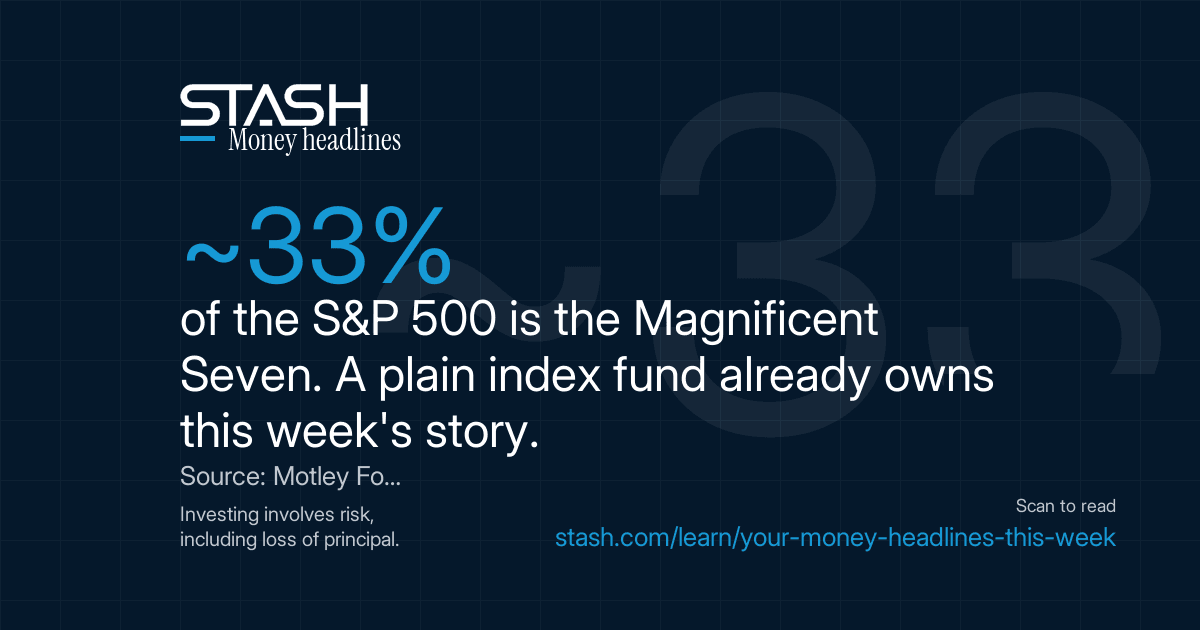
If you hold an S&P 500 fund, a total-market fund like Stocks Nationwide (VTI), Match the Market (IVV), or most target-date retirement funds, a large slice of your money already sits in those seven names. As of July 2026 the Magnificent Seven made up about 33% of the S&P 500, per Motley Fool research summarizing index weights. Roughly one dollar in three of a plain S&P fund rides on seven companies.
Here is how fast that shows up in dollars. Say you have $20,000 invested: $15,000 across index and target-date funds, and $2,000 you put directly into a mix of Microsoft, Apple, or NVIDIA. Those funds already hold about $5,000 of Magnificent Seven exposure (roughly a third of the $15,000). Add the $2,000 you bought on purpose, and about $7,000, or roughly 35% of your money, rides on this week's headlines. This example is hypothetical and for illustration only. Run your own number before you react to any after-hours move.
That is not a knock on index funds. Market-cap weighting puts the biggest companies in the biggest seats, whether you meant to concentrate or not. Knowing the hidden slice is how you stay honest about what "the market" inside your account really is.
The next 48 hours
Wednesday, July 29 stacks the calendar:
2:00 p.m. ET ; Federal Reserve rate decision
2:30 p.m. ET ; Chair Kevin Warsh press conference
After the close ; Microsoft and Meta report
Thursday, July 30:
Morning ; Fed's preferred inflation gauge (PCE) and the first look at Q2 GDP
After the close ; Apple and Amazon report
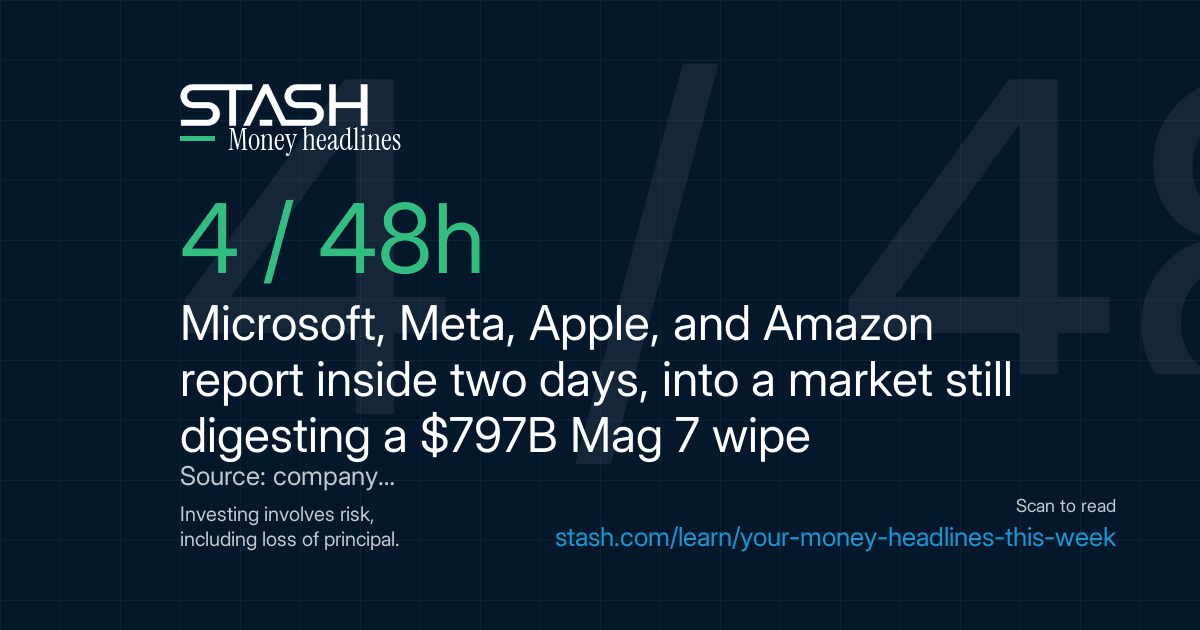
Rates set the mood for how expensive growth stocks look. Then four of the companies that dominate a typical index fund answer the same question Alphabet and Tesla just raised: how much AI spending is the market willing to fund before free cash flow has to catch up.
Ignore the beat-or-miss scoreboard for a minute. Last week's reaction said investors are reading spending versus cash. A strong growth report that comes with another surprise spending plan can still get sold. A quieter spend plan that still grows the business can calm nerves. For an everyday investor, the lesson is not to time the print. It is to notice that when seven names are a third of the index, "the market had a quiet week" and "seven stocks moved a lot" can be the same sentence.
What Stash members did
Over the past 30 days ending July 27, 2026, Stash members kept buying broad funds and trading the megacap names in the headlines. Stocks Nationwide (VTI) led buys at about 6.3% of buy dollars. NVIDIA was the #1 sell at about 5.0% of sell dollars, and still a top-5 buy. Apple and Amazon also showed up on the sell list, per Stash internal trading data.
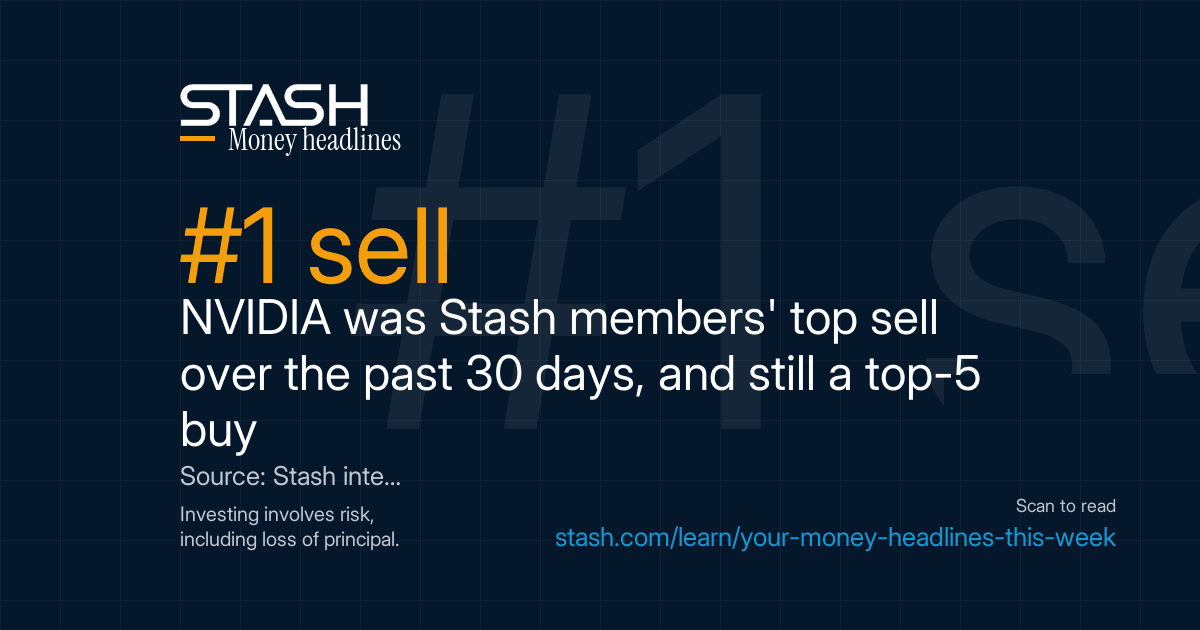
One read: people are funding the index that already holds Microsoft, Meta, Apple, and Amazon, and they are also actively trading the names the news is about. For the weekly scoreboard, see Money in 5.
What to do with that
Before Wednesday's Fed decision or Thursday's after-hours reports, skip the urge to "do something" just because the calendar is loud.
Count the hidden slice. Take what you hold in S&P 500 and broad U.S. funds and remember Mag 7 is about a third of that. Add any shares you bought on purpose. That combined percentage is your real bet on this week's headlines.
Pick a ceiling on any one name. There is no single right number, but no single stock should be able to sink your plan on its own. Sizing is a portfolio decision, not a forecast.
Keep the habit. Regular investing on a schedule (see The Stash Way: Invest Regularly) is how you get through weeks when four megacaps and the Fed collide.
This is general guidance, not personalized advice. How much of any one company fits your money depends on your own situation. None of this is a recommendation to buy, sell, or hold Microsoft, Meta, Apple, Amazon, or any other security.
FAQ: money headlines this week
Do I already own Microsoft, Meta, Apple, and Amazon?
Probably, if you hold a broad U.S. index fund or most target-date retirement funds. Those four are among the largest companies in the S&P 500, and the Magnificent Seven as a group are about a third of the index. Check your fund's top holdings to see the exact weights.
Do I need to do anything before earnings?
Not because of the calendar alone. Reacting to a single report often locks in a feeling, not a plan. If a position has become oversized once you count fund exposure and direct shares, resizing to a ceiling you chose on purpose is a sizing decision. It is not a call on what the stock will do after hours.
Why did Mag 7 fall even when some companies beat estimates?
Markets can sell a beat when the spending story scares them more than the revenue story impresses them. Last week's Alphabet and Tesla reactions put AI spending and free cash flow at the center. That is the lens many investors will use on Microsoft, Meta, Apple, and Amazon this week.
Is an index fund still diversified if Mag 7 is a third of it?
It is diversified across hundreds of companies, and it is also more concentrated in a handful of megacaps than the word "500" suggests. Both can be true. Knowing the concentration keeps you honest about risk without abandoning a long-term fund approach. For the principle, see What Is Diversification?.
Where can I see what Stash members traded this week?
Money in 5 publishes five numbers from inside Stash and the market, including the top buys and sells.
Related reading
What Is Diversification?
Bottom line
If you hold a broad index fund, this week's Mag 7 and Fed headlines are already inside your account. Mag 7 lost about $797 billion in a day. Four of those companies report into that hangover while the Fed speaks. Check your real concentration, pick a ceiling, keep your investing schedule. The news will be loud. Your process does not have to be.
Want a plan that keeps any one name in proportion? Get started with Stash.
Found the dollar check useful? Pass it to someone who only sees the Mag 7 ticker.
Important disclosures
Investing involves risk, including the possible loss of principal. Past performance is not a guarantee of future results.
This article is for educational purposes only and is not a recommendation to buy, sell, or hold any security, including MSFT, META, AAPL, AMZN, NVDA, TSLA, GOOGL, or any exchange-traded fund.
Any hypothetical example is for illustration only. It is not a prediction or guarantee of performance, does not reflect actual results, and does not account for fees, taxes, or other costs.
Stash internal trading percentages reflect aggregate member activity over a stated window. They are not a recommendation and are not predictive of future trading or returns.
Index weights and Mag 7 concentration figures change over time; check your specific fund's holdings for current exposure.
Market-value losses, earnings figures, and Fed calendar times reflect publicly reported information as of late July 2026 and can change.
Stash Investments LLC is an SEC-registered investment adviser. Brokerage products offered by Stash Financial LLC, Member FINRA/SIPC.

Written by
Team Stash
We want to turn money into a source of hope and opportunity. We teach people how to build good habits, save more and make it easy and affordable to get started investing. So far, we’ve helped over 6 million people create a more secure financial future with our expert advice and award winning investing app.
Related articles
financial-news
Jul 27, 2026
LeBron's NBA salary just went from ~$52.8M to ~$3.9M. His wealth didn't. Here's the money lesson.
financial-news
Jul 27, 2026
Your Money Headlines this Week
financial-news
Jul 21, 2026
AMC had its biggest quarter in 106 years. The stock is still down 99%. Both are true.
financial-news
Jul 21, 2026
Who Makes Money From the World Cup? Follow the Cash
financial-news
Jul 09, 2026
You already own NVIDIA (yes, you). Here's how much.
financial-news
Jul 01, 2026
Bitcoin's Worst Month in Years: What It Means for You

By using this website you agree to our Terms of Use and Privacy Policy. To begin investing on Stash, you must be approved from an account verification perspective and open a brokerage account.