5 numbers Stash investors moved this week (SpaceX led at 8.3%)
Published: Jun 26, 2026
• Updated: Jul 21, 2026
Five money numbers worth knowing this week, in two minutes. 8.3% of all Stash member buy dollars went to SpaceX (SPCX) over the past 30 days, per Stash internal trading data. Each card below stands on its own with a link back, so any one is yours to send.
The 5 names everyone bought and sold
NVIDIA is on both lists this week: it's the #4 buy and the #1 sell. That's a market disagreeing with itself in real time, and it's the kind of split you rarely see on a single ticker.
Notice how much of both lists is diversified funds, not single bets.
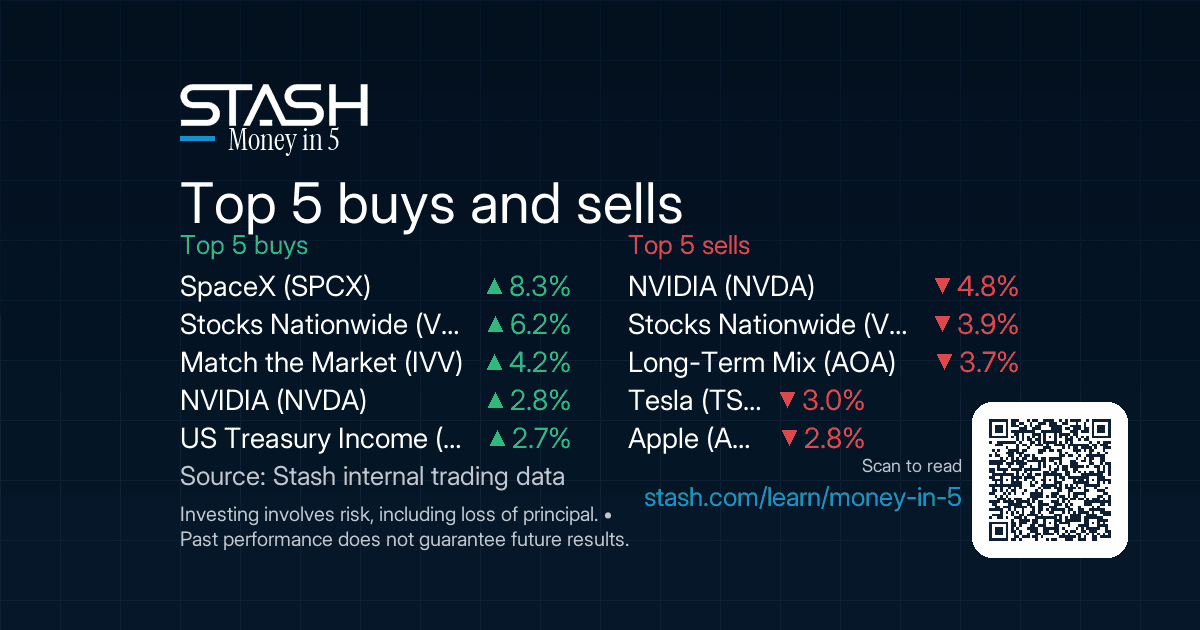
Screenshot this for the group chat that thinks they know what everyone's buying.
Found one worth sending? Screenshot the card above, or send the whole set:
The $1,000 surprise most of us can't cover
Start with a $500 goal. Small and steady beats big and someday.
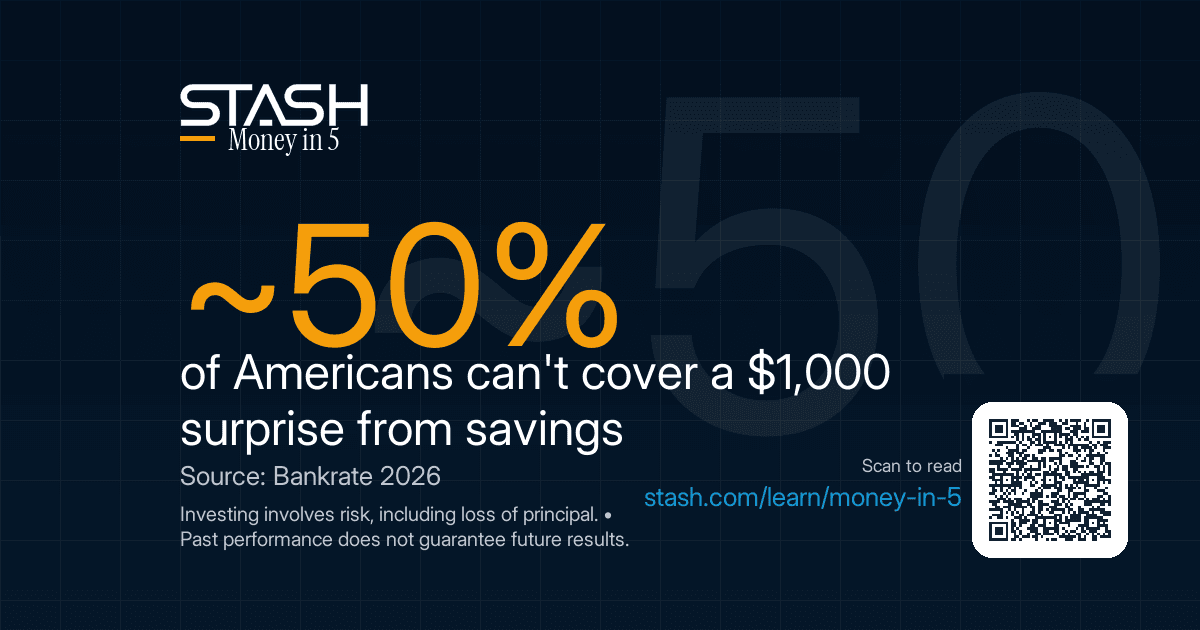
Send this to the friend who still says "I'll start investing next year."
There are fewer stocks to pick than you think
Fewer needles, same haystack. A basket owns the whole field.
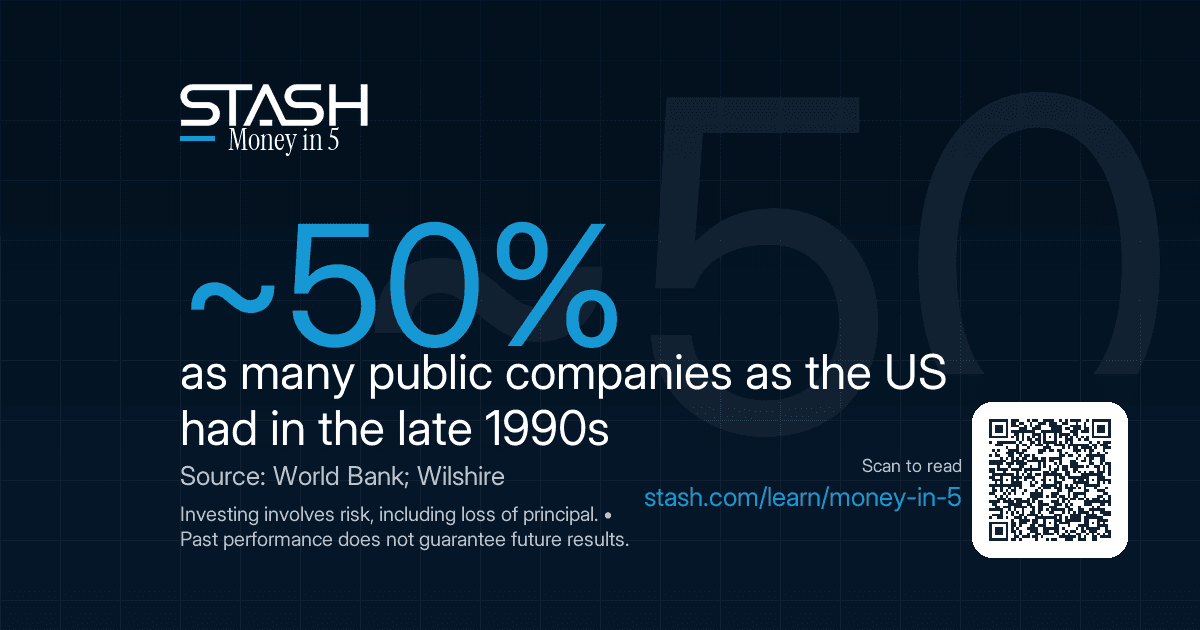
Send this to the person who thinks the market is "too crowded" to start.
Halfway through — one worth forwarding? Screenshot any card, or send the set:
And what they sold most
A sale is a decision, not a panic. Both sides keep a market healthy.
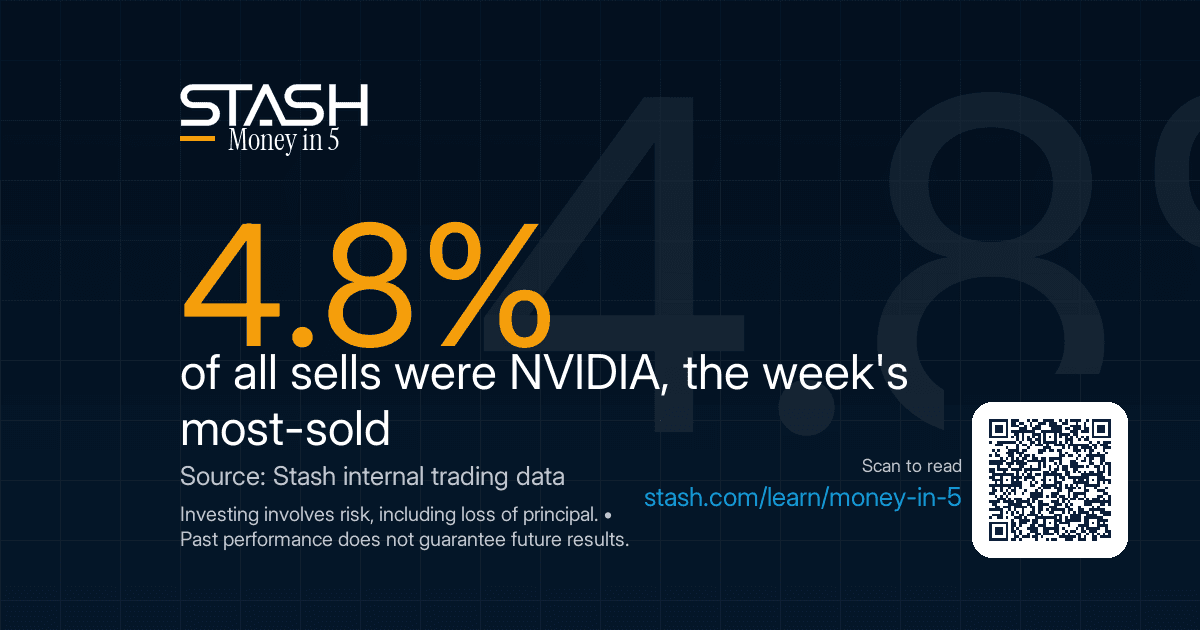
Send this to whoever swears NVIDIA is a one-way ticket.
The $1 million bet on boring
The most-cited investing lesson of the last decade, from a man who bet his own money on it.
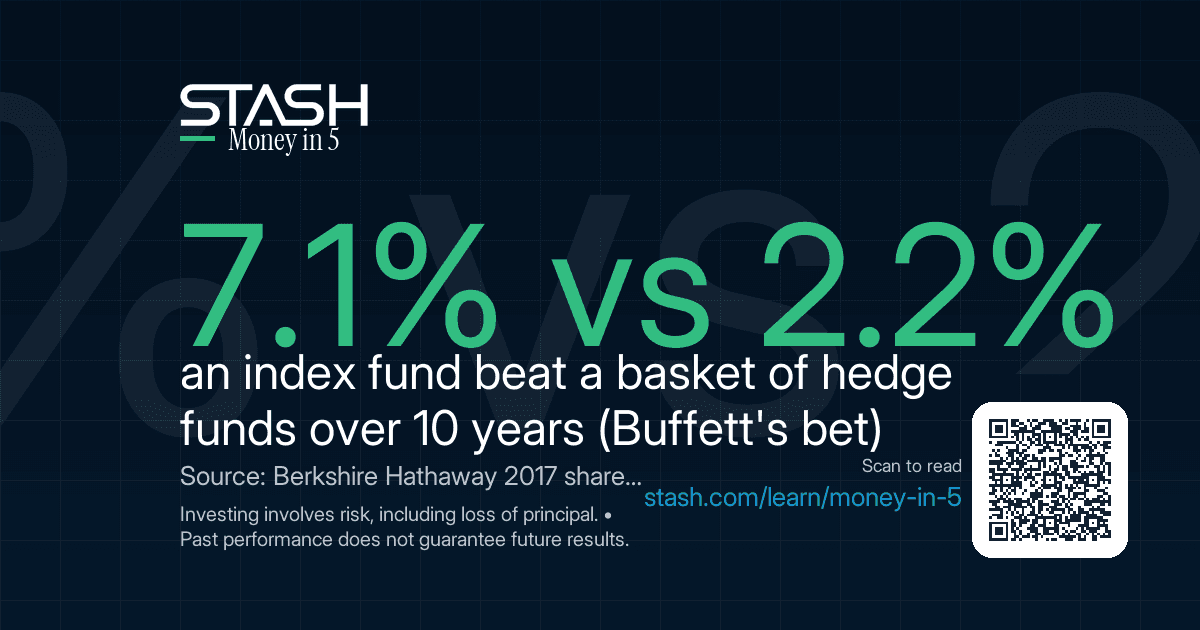
Send this to anyone still waiting for the "right time" to invest.
Frequently asked questions
Is this investment advice?
No. Every number here is educational context, and some are hypothetical illustrations, not a recommendation to buy or sell anything. What is right for you depends on your own situation. See The Stash Way: Invest Regularly.
Are these the right things for me to buy?
No. The Stash figures show what members did in aggregate, not a recommendation for you. The durable habit matters more than any ticker. See Investing Myths That Hold People Back.
Why does Stash share its own numbers as percentages?
Percentages show what the crowd did without revealing anyone's balances or our total flows. Every Stash figure is each name's share of buy or sell activity over the window.
Guess: how much of Warren Buffett's fortune came after age 50?
About 99%. The lesson isn't his stock-picking, it's his staying power. He never stopped, so compounding had decades to do the heavy lifting. See more on this in next week's rotation, or read Morgan Housel's The Psychology of Money for the full breakdown.
Bottom line
The tickers on this list will change next week. Whether your money grows won't. The Stash members with the best long-term outcomes aren't picking better; they're showing up regularly, holding through the noise, and letting time compound. That habit beats the headline every time.
Share these numbers
Know someone who thinks they've missed the market, or started too late? Send them one number. Screenshot any card above, or share the whole set:
Sources
Stash internal trading data: aggregate, anonymized Stash member trading activity over the 30 days ending July 21, 2026 (figures are each name's share of buy or sell dollars).
Emergency savings: Bankrate 2026 Emergency Savings Report (fewer than half of Americans could cover a $1,000 emergency from savings).
Shrinking number of listings: World Bank, "Listed domestic companies, United States," and Wilshire 5000 constituent counts (peak near 8,000 in the late 1990s, roughly half today).
Buffett's bet: a low-cost S&P 500 index fund returned 7.1% annualized vs 2.2% for the hedge fund basket over 2008-2017 (widely reported, including Berkshire Hathaway's 2017 shareholder letter).
Buffett's fortune after 50: Morgan Housel, "The Psychology of Money" (2020), summarizing the share of Buffett's net worth accumulated after age 50.
Important disclosures
This article is for educational purposes only and is not a recommendation to buy, sell, or hold any security. Figures attributed to Stash reflect aggregate, anonymized member trading activity over the stated window and are not a forecast. Hypothetical examples are for illustration only, assume a fixed average annual return that real markets do not deliver, and do not reflect fees or taxes. Investing involves risk, including the possible loss of principal. Past performance is not a guarantee of future results. Stash is a registered investment adviser; what is right for you depends on your specific situation.
Educational only and does not constitute investment, legal, accounting, or tax advice. See full disclosures at www.stash.com/disclosures.

Written by
Ed Robinson
Ed Robinson is the Co-Founder and Co-CEO of Stash, the subscription investing and financial-guidance platform he launched in 2015 with Brandon Krieg to make real financial advice accessible to everyone, not just the wealthy. Before Stash, Ed spent over a decade on Wall Street in institutional finance, and he holds FINRA Series 7 and Series 63 licenses. He earned a Bachelor of Commerce in Finance, Accounting and Management from the University of Sydney and a Graduate Diploma in Financial Planning from FINSIA. Today he leads Stash's mission to help millions of Americans build long-term wealth on a platform built as a Registered Investment Adviser, legally required to act in its customers' best interest.
Related articles
financial-news
Jul 27, 2026
LeBron's NBA salary just went from ~$52.8M to ~$3.9M. His wealth didn't. Here's the money lesson.

financial-news
Jul 27, 2026
Your Money Headlines this Week
financial-news
Jul 21, 2026
AMC had its biggest quarter in 106 years. The stock is still down 99%. Both are true.
financial-news
Jul 21, 2026
Who Makes Money From the World Cup? Follow the Cash
financial-news
Jul 09, 2026
You already own NVIDIA (yes, you). Here's how much.
financial-news
Jul 01, 2026
Bitcoin's Worst Month in Years: What It Means for You

By using this website you agree to our Terms of Use and Privacy Policy. To begin investing on Stash, you must be approved from an account verification perspective and open a brokerage account.